
Top Tourist Places to Visit in Agra for First-Time Travelers
Published on : September 3, 2026
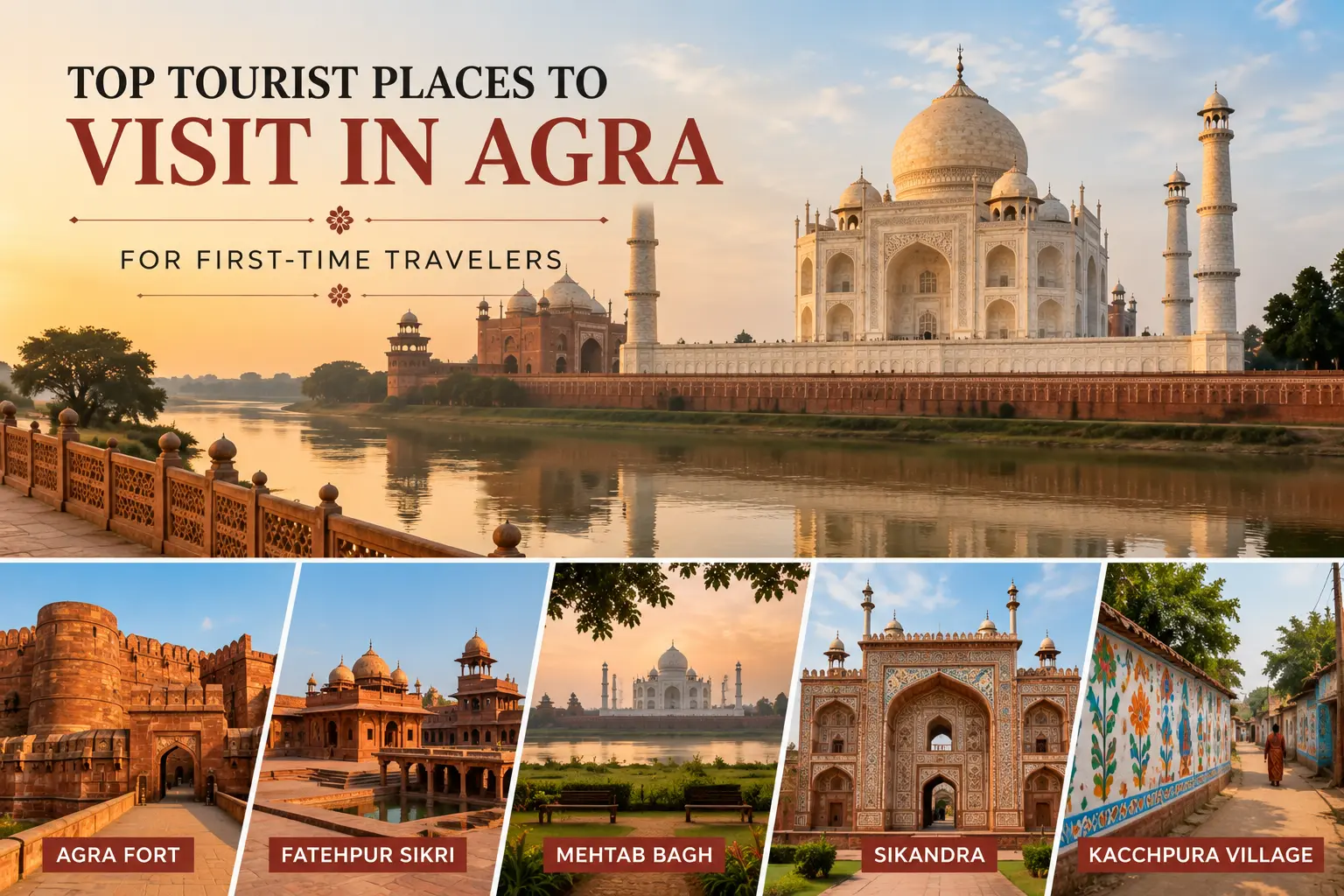
Agra tends to catch first-time travelers off guard. You arrive expecting a monument and leave having understood an empire.
The Taj Mahal is extraordinary. Nothing written about it will quite prepare you for standing in front of it in person. But Agra was the Mughal capital for nearly two centuries. That history shows up everywhere, in the red sandstone fort that rises along the Yamuna River, in the quiet marble tomb across the water, in the markets that have sold silk and spice since Akbar’s reign, and in the riverside village where community wall paintings tell a different kind of story entirely.
Most travelers passing through Agra on a Golden Triangle tour spend one night in the city. That is just enough time to see the headline monuments, but it leaves little room to actually feel the city. Two nights change that. The morning pace feels different. You have time to linger, to visit a site twice, to eat breakfast at a local stall before the tourist traffic builds.
Few places in the world carry the weight of expectation that the Taj Mahal does. The good news is that it holds up.
Shah Jahan commissioned it in 1632 as a mausoleum for his wife Mumtaz Mahal. Construction took 22 years and involved artisans from Persia, Central Asia, and across India. Around 20,000 workers are believed to have worked on the project. The white marble was quarried approximately 300 kilometers away in Makrana, Rajasthan, and transported by elephant to the site.
Sunrise is the right time to visit. The light is soft, the crowds are manageable, and the marble shifts from pale grey to gold to white as the sun climbs. By 10:00 a.m., the temperature and the queue both rise significantly. Walk slowly through the main gateway, take time along the reflecting pool, and get close to the walls. The pietra dura inlay, semi-precious stones set in marble to form flowers, vines, and calligraphy, is best appreciated at close range. It does not photograph the way it looks in person.
One practical note before you go: the Taj Mahal is closed every Friday for general visitors. Check your travel dates carefully. This catches more travelers off guard than you might expect.
If you want to add something different to your Taj morning, a Taj Mahal-facing yoga session with a local instructor is available as a private experience, one of those early-morning moments that stays with you long after the photographs fade.
Agra Fort is about 2.5 kilometers from the Taj Mahal. Most first-time travelers see it on the same day, visiting the Taj at sunrise and arriving at the fort by mid-morning. That works well, as long as you do not underestimate it.
The fort is a UNESCO World Heritage Site and one of India’s most significant Mughal complexes. Emperor Akbar began building it in 1565 using red sandstone. Jahangir and Shah Jahan added marble palaces and audience halls inside. The complex served as a military base, an imperial court, and a royal residence across three generations of rulers.
The place that tends to stay with people is the Musamman Burj, an octagonal marble tower where Shah Jahan reportedly spent his final years confined by his son Aurangzeb. From its windows, you can see the Taj Mahal across the river. The Diwan-i-Aam and Diwan-i-Khas show how the Mughal court functioned as a formal public institution. The Jahangiri Mahal, one of the oldest structures inside, blends Islamic and Hindu design in ways that reflect how Mughal architecture evolved over time.
Plan for 2 to 3 hours. A local guide adds real value here because the historical context makes each space more interesting.
This is one of the most underrated ways to spend an afternoon in Agra.
A narrow path through agricultural fields near Mehtab Bagh takes you into the village of Kachhpura. Community wall paintings created by local girls line the route, part of a youth program that has transformed the lanes into an outdoor gallery. Inside the village sits Humayun’s Mosque, a small and unusual Mughal-era structure rarely mentioned in standard travel guides.
The Kachhpura Village Walk comes with high tea and gives you a view of the Taj Mahal from across the fields. That particular angle, the dome visible above the trees, the sounds of village life around you, feels completely different from anything you experience inside the monument complex. It is best done in the late afternoon, around 04:00 p.m. to 05:30 p.m., when the light is good, and the heat has eased.
Mehtab Bagh translates as “Moonlight Garden.” It sits directly across the Yamuna from the Taj Mahal, on the same north-south axis as the monument. Emperor Babur is believed to have established a garden here long before the Taj was built. What you see today is a restored Mughal-style charbagh with lawns, walkways, and a riverfront viewing platform.
Come here in the late afternoon, around 04:30 p.m. to 06:00 p.m. The Taj changes color as the sun drops. White turns golden, then grey. The garden is calm and rarely crowded. The garden is calm and rarely crowded. Many travelers say this ends up being the moment they actually look at the Taj rather than photograph it.
It is about 4 kilometers from the Taj Mahal and an easy auto-rickshaw ride away.
Most first-time travelers to Agra skip this one. That is a mistake.
Itmad-ud-Daulah’s tomb, built between 1622 and 1628, predates the Taj Mahal by nearly a decade. Nur Jahan commissioned it for her father, Mirza Ghiyas Beg, who held the title of Itmad-ud-Daulah, meaning “Pillar of the State.” It was the first Mughal tomb built entirely of white marble, and it is the monument where pietra dura inlay work, the same technique used on the Taj, first appeared in its full, mature form.
The scale is intimate. You can stand close to the walls and examine the stonework in detail, patterns of lapis lazuli, jasper, and onyx set into white marble with precision that remains astonishing. The marble lattice screens called jalis filter light in ways that make the interior feel cool and quiet even on warm days.
There are rarely large crowds here. You can take your time. More than one seasoned traveler has said this became their favorite site in all of Agra, precisely because of the quiet.
Fatehpur Sikri is about 37 kilometers from central Agra, roughly an hour by road. Emperor Akbar built it in the 1570s as his new imperial capital. He abandoned it about 14 years later, reportedly because of water shortages. The buildings remained largely intact.
Walking through it feels different from visiting a fort or a tomb. This was a functioning capital city with audience halls, royal residences, a vast mosque, and administrative buildings, all built in red sandstone, mostly preserved, and largely empty. UNESCO recognizes it as a World Heritage Site for exactly that reason.
The Buland Darwaza, built to mark Akbar’s conquest of Gujarat, is one of the world’s tallest gateways. The Tomb of Salim Chishti inside the Jama Masjid complex is known for its carved marble lattice screens. The Panch Mahal, a five-storey open pavilion, and the Diwan-i-Khas with its unusual central pillar are the structures most worth spending time in.
The site is open-air and large. Wear good shoes, carry water, and avoid visiting between 11:00 a.m. and 03:00 p.m. in summer.
Many travelers visit Fatehpur Sikri on the drive from Agra to Jaipur, which is efficient since it sits directly on that route. Bespoke India Holidays regularly builds this into the heritage tours of India as a natural midpoint.
About 10 kilometers northwest of central Agra, on the road toward Delhi, is the mausoleum of Emperor Akbar, who ruled from 1556 to 1605. He was Shah Jahan’s grandfather and is widely regarded as the greatest of the Mughal rulers.
The tomb reflects Akbar’s personal philosophy of religious syncretism. The lower levels are red sandstone with Hindu-style decorative elements. The upper levels become progressively more Islamic in character. The surrounding charbagh garden is large, quiet, and well-maintained. Peacocks wander the lawns.
It is much less crowded than the Taj Mahal and Agra Fort. If you prefer to explore at your own pace without the tourist crowds, Sikandra is worth the short drive.
Agra’s craft history is tied directly to its Mughal past. The Art and Craft Tour of Agra takes you into working studios where artisans still practice pietra dura, setting tiny pieces of semi-precious stone into marble by hand, just as they did when the Taj was being built. Watching it up close changes how you see the Taj Mahal afterwards.
Zardozi embroidery, a metal threadwork tradition that once adorned royal tents and court garments, is also produced in Agra. The city is additionally known for its leather industry, a legacy of Akbar’s era when shoemakers from across the empire were summoned to the capital.
For shopping, Kinari Bazaar near Jama Masjid is best for textiles, embroidery, and traditional merchandise. Sadar Bazaar covers leather goods, clothing, and petha, the ash gourd sweet that is Agra’s most famous food product. Panchhi Petha near Hari Parbat Crossing is one of the most established shops for buying it.
If you visit Kinari Bazaar in the early morning, around 07:30 a.m. to 09:00 a.m., you will find breakfast stalls serving bedai, a spiced lentil-stuffed fried bread, alongside jalebi. It is the local breakfast, and it is worth planning your first morning around.
Day 1: Taj Mahal at sunrise, Agra Fort, Itmad-ud-Daulah, Mehtab Bagh at sunset.
Day 2: Kachhpura Village Walk in the afternoon, Akbar’s Tomb at Sikandra in the morning, Fatehpur Sikri as a half-day excursion, craft studios and Sadar Bazaar in the evening.
October to March is the most practical window for first-time visitors. Mornings are cool, afternoons manageable, and the light is good for photographing white marble against clear skies.
December and January often bring early morning fog over the Yamuna. This can result in occasional delays of sunrise views at the Taj. Build flexibility into those days.
April through June regularly exceeds 40°C. Do all outdoor sightseeing before 10:00 a.m. and after 04:00 p.m. The monsoon months of July through September bring humidity and occasional heavy rain, though the monuments can look striking under an overcast sky.
One full day covers the Taj Mahal, Agra Fort, Itmad-ud-Daulah, and Mehtab Bagh. Two days let you add Fatehpur Sikri, Akbar’s Tomb, the Kachhpura Village Walk, and the local markets without rushing.
The most efficient approach is to stop there on the drive from Agra to Jaipur. It sits directly on that route and adds less than an hour to your journey.
Sunrise is the best time to visit the Taj Mahal. The light is best, the crowd is smallest, and the temperature is comfortable. Avoid the 10:00 a.m. to 03:00 p.m. window in any season.
Yes, Agra is a part of the classic Golden Triangle route, along with Delhi and Jaipur. It serves as the natural midpoint and is usually the most memorable stop on the route.
The Taj Mahal at sunrise, Agra Fort in the late morning, and Mehtab Bagh at sunset. That sequence covers the three most important sites and gives you a genuinely complete picture of what makes Agra worth the trip.
Our travel experts are here to help you craft the perfect itinerary — stress-free and tailored just for you.
Contact Our Travel Experts
India is one of the most charming places in the world that grab the attention of a number of tourists…
Malaysia, Singapore and Dubai have always remained most preferred destinations for health tourism but from a few years India has…
Jaipur can feel very different depending on when you visit. In winter, mornings can be cool enough for a jacket,…
By:Acodez Web
October 13, 2026
Step into Old Delhi and you step into a different side of the capital. Narrow lanes wind past old havelis, spice shops, mosques, and busy…
Read Post
By:Acodez Web
September 29, 2026
Six centuries of traders have passed through Kochi, and almost all of them left something behind. The Portuguese built the first European church in India…
Read Post
By:Bespoke admin
April 18, 2010
Kerala Ayurveda It’s an irony of the times we live in, which is little appreciated, though taken for granted: Alternative medicine is today main-stream and…
Read Post