
Taj Mahal Architecture Explained: Design, Domes, Minarets & Mughal Details
Published on : September 24, 2026
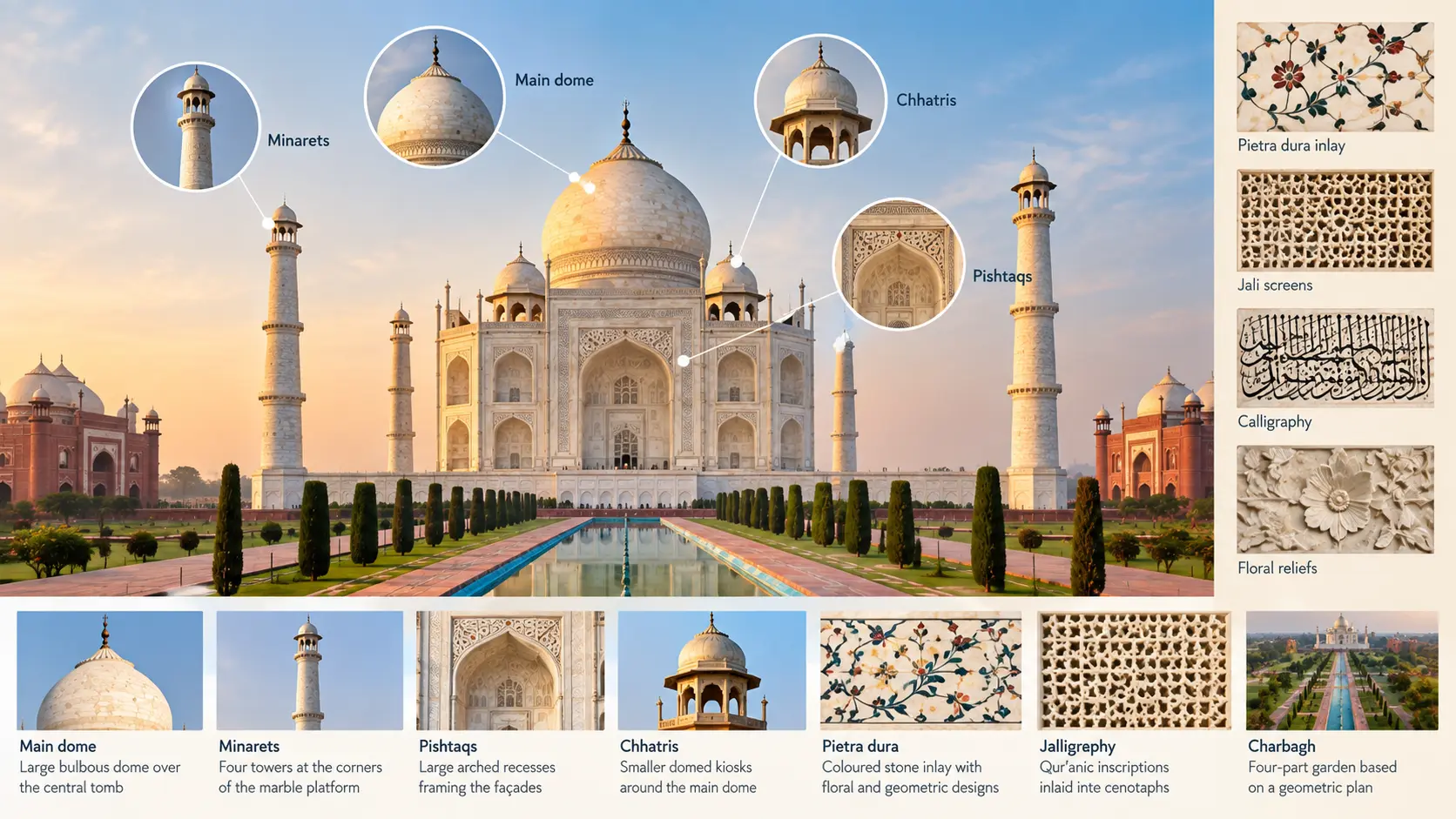
What makes the Taj Mahal look so perfectly balanced? It is not only the famous white marble. The dome, four minarets, arches, carved screens, inlay work, and surrounding garden were all planned as part of a carefully designed complex.
At Bespoke India Holidays, we believe understanding these details adds another dimension to a visit. The Taj Mahal architecture is a mix of Mughal, Persian, Islamic, and Indian influences. The symmetry and proportion shaping the overall design. This article explores the architectural design of the Taj Mahal, from its dome and minarets to its decorative details, materials, and wider layout.
The Taj Mahal architecture style mainly belongs to the Mughal tradition. It also has Persian and Islamic influences alongside Indian architectural forms and craftsmanship. The design follows the Shahjahani preference for strict geometry, bilateral symmetry, and carefully graded materials and decoration.
You can see this style in several parts of the monument:
The architectural design of the Taj Mahal therefore represents more than one influence. Mughal builders combined different architectural traditions within a tightly controlled plan. The Taj Mahal’s Mughal architecture in India is a blend of different traditions brought together within one carefully planned complex.
You can explore this wider Mughal legacy at Agra Fort, where later Mughal rulers added palaces, halls, mosques, and other structures.
The main architectural features of the Taj Mahal are its central dome, four minarets, large arches, chhatris, marble inlay, calligraphy, carved marble screens, and charbagh garden. The table below shows what to look for in the Taj Mahal:
| Feature | What to look for |
| Main dome | Large bulbous dome over the central tomb |
| Minarets | Four towers at the corners of the marble platform |
| Pishtaqs | Large arched recesses framing the façades |
| Chhatris | Smaller domed kiosks surrounding the main dome |
| Pietra dura | Coloured stone inlay with floral and geometric designs |
| Calligraphy | Qur’anic inscriptions inlaid into marble |
| Jali screens | Carved marble screens around the cenotaphs |
| Charbagh | Four-part garden based on a geometric plan |
These elements appear throughout the complex, but each serves a different structural or decorative purpose.
The architectural design of the Taj Mahal follows a central axis, with the main mausoleum forming the dominant element. The mosque and guest house mirror each other on either side. The minarets mark the four corners of the main platform.
The symmetry continues through the wider complex. The garden uses a four-part layout, while repeated arches, domes and decorative patterns keep the different structures visually connected. There is one notable exception. Shah Jahan’s cenotaph was placed beside Mumtaz Mahal’s rather than directly mirroring it. The actual graves lie in the lower chamber beneath the cenotaphs.
The main dome is the central feature of the mausoleum. It rises from a cylindrical drum and is surrounded by four smaller chhatris that repeat its form on a smaller scale.
The dome has several recognisable details:
The lotus motif appears again on the chhatris and other parts of the structure. The finial combines Persian and Indian decorative influences, adding another detail to the upper profile.
The Taj Mahal has four minarets positioned at the corners of the main marble platform. Each tower has three principal sections, balconies, and a small chhatri at the top. The minarets frame the mausoleum and strengthen the vertical proportions of the composition. Their placement also gives the monument a clear three-dimensional outline when viewed from different angles.
The towers were positioned slightly outside the main plinth. The official Taj Mahal site notes that this would help keep a collapsing minaret away from the central tomb.
The decorative work combines stone inlay, marble carving, floral motifs, and calligraphy. Craftsmen concentrated these details around façades, arches, cenotaphs, and other selected surfaces.
Pietra dura is a stone-inlay technique in which coloured stones are cut and fitted into marble to create decorative patterns. At the Taj Mahal, craftsmen used it for floral and geometric designs across the exterior and interior.
A finely carved marble jali surrounds the cenotaphs inside the mausoleum. The perforated screen creates a detailed enclosure while allowing light to pass through. UNESCO describes the screen as one of the complex’s notable examples of marble craftsmanship.
Qur’anic passages appear throughout the complex, with black marble or jasper lettering set into white marble. The inscriptions form part of the architectural composition around entrances and other surfaces. Amanat Khan of Shiraz is associated with the calligraphic work, and his signature appears within the inscriptions.
The marble also carries carved flowers and vines. These naturalistic motifs appear alongside the inlay work and reflect the Mughal use of plant forms in architectural decoration.
If you want to see these details alongside other Mughal sites in Agra, Bespoke India Holidays’ 7-day Golden Triangle Taj India Heritage tour includes the Taj Mahal as part of a wider heritage itinerary.
The main mausoleum is clad in white Makrana marble, while red sandstone appears in the mosque, guest house, and other parts of the complex. Coloured and semi-precious stones provide the inlay work.
The main materials include:
The contrast between the white marble mausoleum and the red sandstone structures also helps distinguish the central tomb from the surrounding buildings. That combination explains why the architectural features of Taj Mahal remain as important to its identity as the white marble itself.
Bespoke India Holidays also covers other Mughal sites in its guide to places to visit in Agra beyond the Taj Mahal, which can help place the monument within Agra’s wider heritage landscape.
The Taj Mahal architecture is easier to admire when you know exactly where to look. The dome, minarets, marble inlay, carved screens, and planned layout reveal the skill behind one of India’s most popular monuments.
Bespoke India Holidays creates private, tailor-made India tours that give you time to experience Agra beyond a quick Taj Mahal visit. Explore the monument alongside Agra Fort, Fatehpur Sikri, and other highlights as part of an India heritage tour or a Golden Triangle journey through Delhi, Agra, and Jaipur.
We arrange the hotels, private transport, guides, and sightseeing around your schedule. You can focus on seeing the Taj Mahal up close and understanding the architectural design that makes it so remarkable.
UNESCO identifies Ustad-Ahmad Lahori as the main architect. The official Taj Mahal site also records the involvement of several architects, craftsmen, and specialists, reflecting the team-based nature of the project.
The main construction began around 1631, and the principal mausoleum was completed in 1648. The surrounding buildings and gardens were completed around 1653.
White marble forms the exterior of the main mausoleum and provides the surface for carved decoration, calligraphy, and stone inlay. The material also set apart the tomb from the red sandstone structures surrounding it.
Pietra dura is an inlay method in which coloured stones are cut and fitted into marble to create decorative designs. The Taj Mahal uses the technique extensively for floral and geometric motifs.
The white marble responds to changing natural light, so the monument can appear different at different times of day. The official Taj Mahal site describes changes in its appearance from morning through evening and under moonlight.
Try looking closely at the dome, minarets, pishtaq arches, pietra dura panels, marble jali, and calligraphy. These details show how the structure combines large-scale planning with fine craftsmanship.
Our travel experts are here to help you craft the perfect itinerary — stress-free and tailored just for you.
Contact Our Travel Experts
The magical land of Rajasthan, the northern desert state of India, beckons everyone to leave all the trappings of modern…

Planning senior citizen tours in India gives older travellers plenty of ways to explore the country without rushing from one…
Like a sophisticated sand castle emerging from the semi-desert wilderness, this architectural wonder was constructed with Jaisalmer sand, cement and…
By:Bespoke admin
May 8, 2013
The magical land of Rajasthan, the northern desert state of India, beckons everyone to leave all the trappings of modern life behind and discover what…
Read Post
By:Bespoke admin
July 3, 2025
Planning a luxury honeymoon tour in India is complete with choosing the perfect destination, mode of transportation, and personalised arrangements that cater to the two…
Read Post
By:Acodez Web
September 29, 2026
Six centuries of traders have passed through Kochi, and almost all of them left something behind. The Portuguese built the first European church in India…
Read Post