
Best Hill Stations in Kerala for a Scenic Luxury Escape
Published on : September 30, 2026
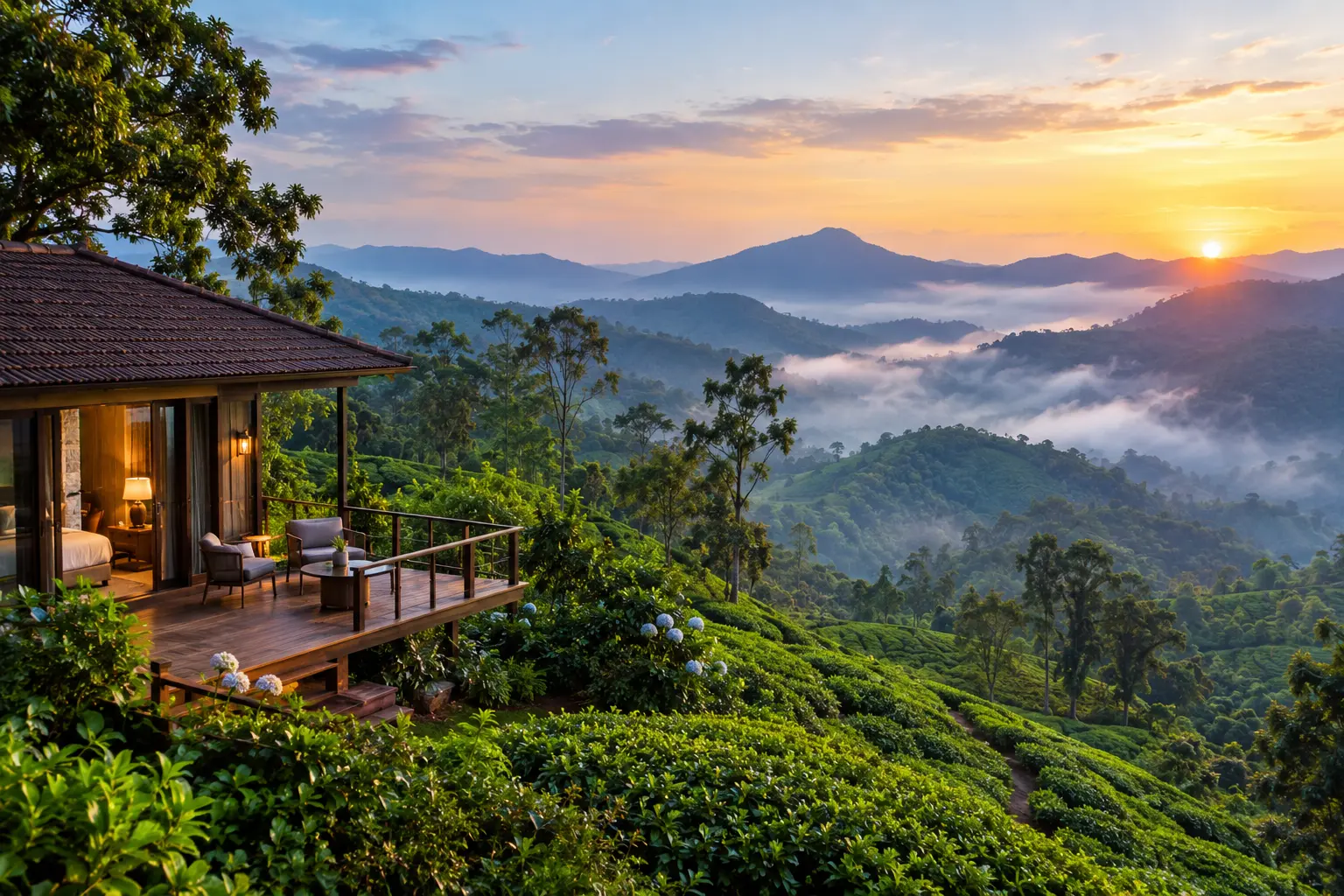
Kerala is usually pictured as backwaters and beaches. Ask anyone who has actually spent time in the state’s hills, and the story changes its character. Something like: they stepped out of the car, and before they could even reach for their camera, the air does something to them. It’s cooler, thinner, and carries the faint green smell of wet tea leaves and woodsmoke. Somewhere below, the coast is still sweating in the afternoon heat. Up here, they actually needed a sweater. Yes, that is exactly why you should add a hill station to your Kerala visit plan.
Kerala’s Western Ghats run through the state like a green spine. Where that spine rises highest, you find some of the most beautiful backdrops in South India: tea estates that ripple over the hills like folded velvet, mist that rolls into valleys before breakfast, and mornings cool enough for winterwear. For a luxury traveler, a Kerala hill station is not a detour but the best part of the trip.
Let’s take a walk through the list of best hill stations in the state and build the mountain half of your Kerala tour package for a balance between backwaters and the coast.
Kerala’s coast, for all its charm, runs warm, especially between March and May. However, the hill districts sit anywhere from 700 to over 2,100 meters above sea level, which changes the entire feel of a trip. Days are warm and clear. Nights ask for a warm woven sweater. Locations like Munnar have functioned as escapes from the plains since the era of the British planters, and that instinct still holds up today.
There’s also a change in rhythm that’s harder to explain until you’ve felt it. While a backwater cruise is about drifting past the world, a beach afternoon is about doing nothing at all. But a hill station adds a third register: walking between rows of tea bushes at sunrise to burn off the mist over a valley, or simply sitting on a private veranda with a cup of estate-grown tea that does the work a spa treatment usually does elsewhere.
| Hill Station | Elevation | Best For | Ideal Stay |
| Munnar | ~1,600 m | Tea estates, iconic views, easy luxury access | 2–3 nights |
| Wayanad | 700–2,100 m | Wildlife, coffee and spice plantations, forests | 2–3 nights |
| Vagamon | ~1,100 m | Meadows, pine forests, quiet luxury | 2 nights |
| Thekkady (Periyar) | ~900 m | Wildlife sanctuary, spice country, boutique stays | 2 nights |
| Nelliyampathy | ~1,100–1,600 m | Off-the-map orange groves, solitude | 1–2 nights |
If there is one name that answers “what is the famous hill station in Kerala,” it is Munnar. Set at roughly 1,600 meters in the Western Ghats, at the point where the Muthirapuzha, Nallathanni, and Kundala streams meet, Munnar was once the summer retreat of the British administration in South India, and its tea legacy dates back to plantations first established in the 1880s, according to Kerala Tourism, the state’s official tourism board.
Munnar’s tea estates stretch for miles, and many of the region’s boutique properties and plantation bungalows are built directly into that landscape. As a result, the view from your room is often the same one postcards use. Eravikulam National Park, home to the endangered Nilgiri tahr, and Anamudi, South India’s highest peak at roughly 2,700 meters, are close if you want a morning of trekking before an afternoon of doing nothing at all.
Good to know: Once every twelve years, the hills around Munnar turn soft blue-purple when the rare Neelakurinji flower blooms. It last happened in 2018, so the next bloom is expected around 2030.
Give Munnar at least two to three nights. See how it fits alongside the rest of the state; our team has mapped it out in 15 Best Places to Visit in Kerala for a Luxury Holiday.
Wayanad is Kerala’s answer for travelers who want their hill station to feel more wild than manicured. Munnar is Kerala’s most photographed hill station; Wayanad is its most alive. Munnar is about tea; Wayanad is about biodiversity.
The district’s altitude ranges from about 700 to 2,100 meters, as per Kerala Tourism’s own topography data, which means the landscape here refuses to sit still: dense forest one moment, open coffee & spice plantations the next, paddy fields catching the light after that.
Elephant herds run through the district, the Edakkal Caves hold petroglyphs believed to date back thousands of years, and Chembra Peak’s heart-shaped lake has become one of the most photographed spots in Kerala. Luxury accommodation here leans into plantation bungalows, treehouse-style villas, and boutique resorts built around coffee estates.
Two to three nights gives enough room for both wildlife activities and simple downtime like a coffee-estate breakfast or a quiet boat ride on Pookkode Lake.
We don’t talk about Vagamon nearly as much as we should, and honestly, that’s part of its charm. Sometimes called the “Scotland of Asia,” it sits at around 1,100 meters across the Idukki and Kottayam districts. It has a different character from Munnar: rolling grass meadows instead of dense tea rows, a pine forest that would look at home in the American Northeast, and a noticeably slower rhythm.
It is also one of India’s better spots for paragliding, thanks to its open meadows and steady thermals. If you’re the type who wants one adrenaline-soaked morning bracketed by two completely lazy ones, this is Kerala’s under-the-radar hill station.
Thekkady sits beside the Periyar Wildlife Sanctuary and blends the hill-station cool of the Western Ghats with genuine wildlife encounters. Boat rides on Periyar Lake, guided nature walks, and access to the region’s cardamom, pepper, and clove plantations make it one of the more complete hill destinations for travelers. Part cool-climate escape, part working spice country.
It also pairs beautifully with a broader South India itinerary. It works especially well for guests already drawn to our wellness and Ayurveda experiences, since several boutique properties here combine forest views with traditionally trained Ayurvedic practitioners. Two nights is typically enough, especially as an addition to a Munnar or Kumarakom stay.
If you want to see a side of Kerala’s hills that most visitors never reach, Nelliyampathy delivers. Located in the Palakkad district at elevations that climb past 1,000 meters, it is known for orange groves, coffee plantations, and valley views that stretch toward the Nelliyampathy and Anamalai ranges, with a fraction of the visitor traffic found elsewhere.
Do not expect the same density of five-star properties here. What you get instead is space, mist, and a hill station that still feels genuinely undiscovered. One to two nights is the right amount of time, ideally as an add-on for travelers who have already done the more established stops.
October through March is, without much argument, the best stretch for tourists to travel hill stations and other places in Kerala. Daytime temperatures in Munnar and Wayanad typically sit in a comfortable range, the air is clear, evenings are properly cool, and the monsoon-fed valleys are still lush and green.
For a month-by-month breakdown across the state, our guide to the best time to visit Kerala covers how the hills, backwaters, and coast behave throughout the year.
No list can tell you which two hill stations actually belong in your trip, how many nights each one deserves, or how to cord them together with the backwaters and the coast without losing entire days to travel.
That’s the part we do. Bespoke India Holidays has spent years building 100% tailor-made journeys across India, and Kerala’s hill country is one of our favorite chapters to design. We know which Munnar estates have the rooms worth waking up early for, which Wayanad properties will actually get you close to the wildlife, and which quiet corner of Vagamon or Nelliyampathy is worth the extra drive. Our itineraries come with a private driver, a guide who knows the region properly, and a pace that’s built around how you actually like to travel, not a fixed template.
We’re proud to be a National Tourism Award-winning company and a TripAdvisor Travelers’ Choice pick two years running. Still, honestly, the reviews from guests who’ve stood in a Munnar tea garden at sunrise say it better than any award can. Talk to our travel experts and let’s start sketching out a trip that actually fits the way you want to travel.
Munnar. It’s known for its endless tea estates, cool climate, and easy access from Kochi, and it’s usually the first name that comes up on any Kerala hill stations list.
Munnar, Wayanad, Vagamon, Thekkady, and Nelliyampathy are the five we recommend most, each with a different personality.
Two to three nights per hill station is usually the sweet spot. Most of our guests choose one or two hill stations, with time in the backwaters and along the coast, for a well-rounded trip.
October through March. December to February is the driest, while October and November offer greener scenery and noticeably fewer crowds.
Very much so. Munnar and Vagamon in particular are longtime favorites for their privacy, cooler climate, and plantation-view stays, and both combine easily with a few days by the coast or backwaters.
Our travel experts are here to help you craft the perfect itinerary — stress-free and tailored just for you.
Contact Our Travel Experts
“God’s Own Country,” that’s how locals call this land. Spend three days here, and you’ll stop thinking of it as…

India is a place that has nature that remains wild and natural. As you go through the forests, grasslands, and…
From the south bank of the free flowing river Tungabhadra spills a tiny village, Hampi, the ruined remains of Vijayanagar…

By:Acodez Web
January 10, 2026
India is a country that reflects the essence of many worlds in one land. From their northern snow-capped mountains to the rainforest in the south,…
Read Post
By:Acodez Web
September 8, 2026
Often people ask, where do you actually go shopping in Delhi, is the market worth your rupees, and which are the best in the city? …
Read Post
By:Acodez Web
September 24, 2026
What makes the Taj Mahal look so perfectly balanced? It is not only the famous white marble. The dome, four minarets, arches, carved screens, inlay…
Read Post