
Best Delhi Sightseeing Places: A Complete Guide for First-Time Visitors
Published on : September 8, 2026
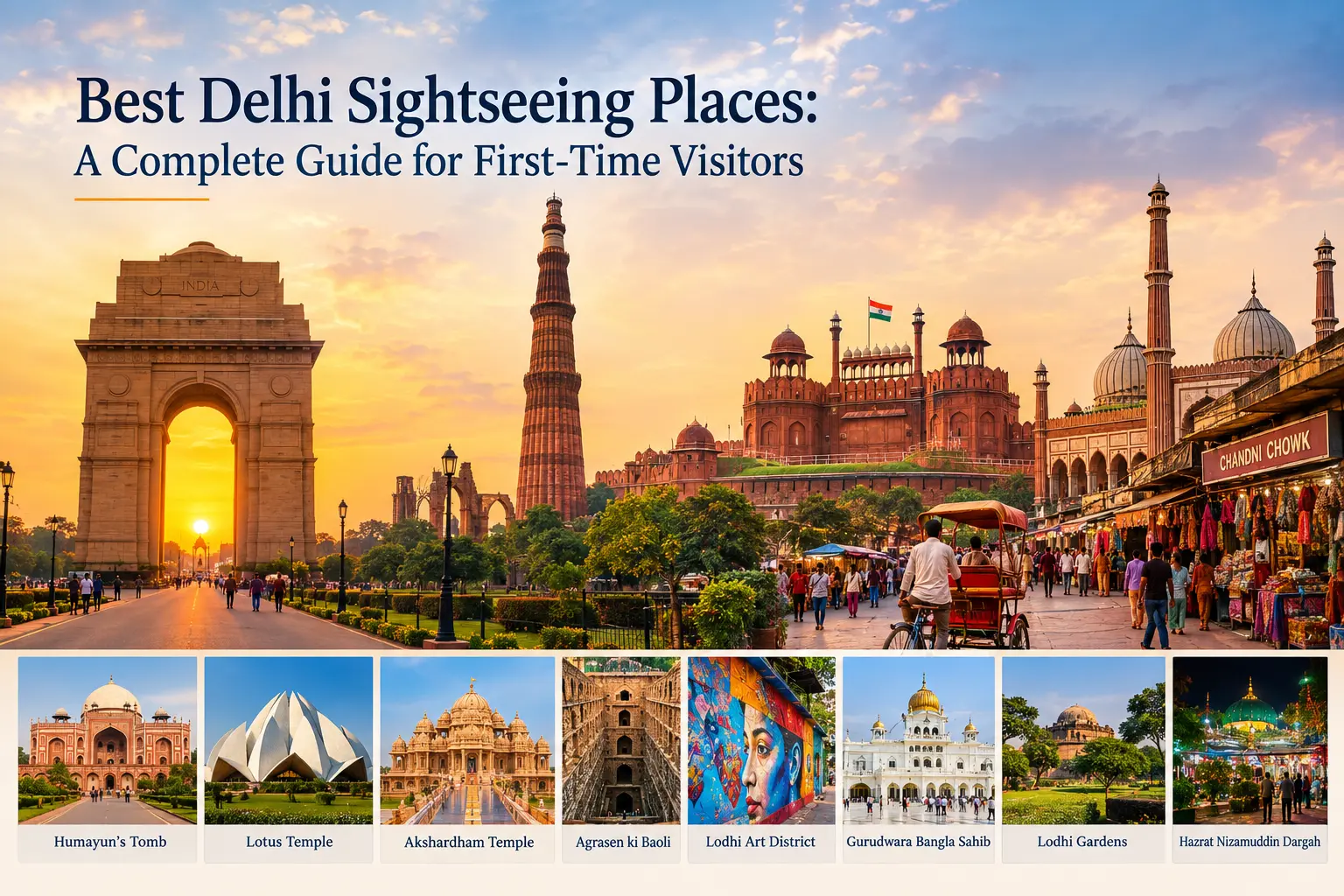
Delhi rarely gets the attention it deserves. Most itineraries treat it as a one-night stopover, tick a box or two, and move on to Agra, Jaipur or any other North Indian city. And then, somewhere between a sunrise at Humayun’s Tomb and a cup of chai on a rooftop overlooking Jama Masjid, they realize they’ve fallen for the city.
With over eight hundred years of history, India’s capital has been the seat of at least seven cities; rebuilt, ruled, and reinvented more times than almost anywhere else on earth. Delhi rewards a slower pace for sightseeing, those places that travel between time, culture, and architecture.
Our Golden Triangle itinerary is for travelers across the globe who actually want to see Delhi, not just tick a box or two and pass through.
Every empire that ruled North India left something behind in Delhi as a new chapter, and the city wears every single one of them right out in the open. You are never looking at a single era; you are looking at centuries stacked on top of one another, often within view of each other.
Delhi is the only capital city with three separate UNESCO World Heritage Sites and if your sightseeing spots list has room for only three stops, let it be these:
Built in 1199 by Qutb-ud-din Aibak in the Mehrauli area of present-day South Delhi, the Qutub Minar is the tallest brick minaret in the world (72.5 meters) and the earliest major monument of the Delhi Sultanate. Around the tower, there are inscriptions of Quranic texts and other Indo-Islamic literature. UNESCO added it to the World Heritage List in 1993.
Its surrounding complex holds the fourth-century Iron Pillar which has stood in the open air for over 1,600 years without rusting through. Metallurgists still study how. You’ll also find ruins of ancient Hindu and Jain temples around. India’s earliest mosque, Quwwat-ul-Islam, also sits next to it.
Long before Shah Jahan built a marble monument to grief in Agra, his great-grandmother built one in Delhi. Humayun’s Tomb is the most underrated stop in the entire city.
Commissioned in 1565 by Empress Bega Begum for her husband, the Mughal emperor Humayun, this red sandstone and marble mausoleum introduced the charbagh (four-quartered paradise garden) to Mughal India. Delhi Tourism notes the Tomb also sheltered the last Mughal emperor before his capture by the British in 1857.
In the same year as Qutub Minar, Humayun’s Tomb was also inscribed on UNESCO’S official list. Take some time to visit the nearby Sundar Nursery, which houses fifteen restored Mughal-era monuments and Delhi’s first arboretum with 300+ tree species.
Shah Jahan built the Red Fort, also known as Lal Qila, between 1638 and 1648 as the seat of Mughal power when he shifted the capital from Agra to Delhi. For over two centuries, it served as the empire’s ceremonial and political heart. Beyond the red stone citadel, there is the Diwan-i-Aam (Hall of Public Audience) and the beautiful white marble Diwan-i-Khas (Hall of Private Audience). As an example of Mughal architecture that blends both Persian and Indian influences, UNESCO recognized it as a World Heritage Site in 2007.
As you visit Red Fort, don’t miss Jama Masjid, one of the largest mosques in India, which can hold 25,000 worshippers for prayer at once. Built with red sandstone and white marble, this minaret can give you a view of the entire Old Delhi from its rooftop.
Once out of it, take a cycle-rickshaw to Chandni Chowk, one of Asia’s oldest and busiest markets, with spice sacks stacked as high as the shopkeeper, handmade jewelry shops, and whatnot. Lastly, head to the Parathe Wali Gali for hot, stuffed fried parathas and jalebis.
Beyond the UNESCO sites, there’s a part of Delhi that no one puts on a postcard. Newer landmarks tell a different story, and they’re just as essential to any list of sight seeing spots in Delhi.
Finished in 1931 by British architect Edwin Lutyens, the India Gate honors the 84,000 Indian soldiers who died between 1914 and 1921 in the First World War and along the Northwest Frontier in the Third Anglo-Afghan War. Respectfully, this 42-meter-high war memorial is the best sunset spot in the city.
Rajpath, formerly named Kartavya Path is where most visitors come for a golden-hour walk, and it delivers every time. It looks beautiful in the evening when the avenue, with huge lawns on both sides lights up, people take boat rides on the adjacent ponds, food carts line up, and families sit and spend time, trying to exhale the chaos.
At the western end is the Rashtrapati Bhavan (the Official Residence of the President of India). Spread over 330 acres, this mansion reflects neo-classical architectural design.
One of the most scenic sightseeing places in Delhi is the Lotus Temple, a Bahá’í house of worship built in 1986. It is shaped like twenty-seven marble petals frozen mid-bloom and is one of the world’s most visited buildings.
Then there is the Akshardham Temple, consecrated in 2005, that took years for thousands of artisans to hand-carve across a hundred acres. Walk through it, and you’d never guess it’s younger than most of the visitors because it somehow still manages to feel ancient.
Gurudwara Bangla Sahib is a luminous white Sikh shrine where a community kitchen called Langar quietly feeds tens of thousands of people every single day. No questions asked. Guru Har Krishan, the eighth Sikh Guru stayed here in 1664 to help people suffering from smallpox.
Volunteers work there selflessly as Sewa, regardless of caste or creed.
Dress in a very simple, modest attire, cover your head with a scarf or cloth, take off your shoes, and wash your feet before entering.
While the classic sightseeing places in Delhi are the most talked about, there also lie lesser-visited treasures with much deeper cultural reflection of the city:
This ancient stepwell is hidden amid the high-rises of central Delhi, with 108 red-sandstone steps leading into its historical depths. As you enter, the traffic noise starts to vanish, replaced by cool shadows and an eerie stillness.
Lodhi Garden is an attractive blend of 15th-century Sayyid and Lodi Dynasty Tombs surrounded by lawns, making it not just a sightseeing spot in Delhi but also great for brief walks.
Lodhi Art District, India’s first open-air public art gallery, is just a stone’s throw from the garden, where neighborhood walls are covered with over fifty contemporary murals, turning the street a larger-than-life canvas.
Dedicated to Sufi saint Nizamuddin Auliya, at this famed shrine you can experience the soul-stirring devotional music of live Qawwali sessions on Thursday evenings. With the scent of fresh roses and burning incense, world-renowned qawwals break into hypnotic Sufi music.
Delhi is not a museum of former dead empires, but a city that’s still very much writing itself. Anyone can hand you a list of the best places to go. Understanding why they matter, and not losing half your day in queue for a ticket, or having someone beside you to explain why a garden was laid out in four quarters instead of one without sounding like a textbook. That’s the part we care about, and it’s what makes us the best luxury tour operators in India.
At Bespoke India Holidays, we build your Delhi trip around your pace. We are an inbound tour operator approved by India’s Ministry of Tourism and a member of ASTA, ATIA, and IATO. Our team has spent years building this kind of first-day-in-India experience for travelers.
Design your trip with our specialists, tell us what your priorities are and we’ll take it from there, right through the best sightseeing places in Delhi India.
In two full days, you can comfortably cover the highlights. However, three days in Delhi allow a more relaxed pace, additional stops like Akshardham, and time for shopping or a food walk in Old Delhi.
From the moment you arrive at the Indira Gandhi International Airport (DEL), our representative greets you at the gate with expedited clearance. After that, we provide private luxury vehicles for all transfers and sightseeing tours, ensuring your safety and comfort throughout.
Absolutely yes, it’s perfect. Through our Golden Triangle with Wildlife packages, after your stay in Delhi, we visit Agra’s Taj Mahal and Ranthambore’s tiger reserves, all in a private car just for you.
While a guide is not mandatory, it adds considerable depth. Particularly at sites like Humayun’s Tomb and the Qutub complex, where the history isn’t always evident from the architecture alone, our expert guides can help you understand the core of the place you’re standing in.
Our travel experts are here to help you craft the perfect itinerary — stress-free and tailored just for you.
Contact Our Travel Experts
India is home to some of the top luxury hotels in the world, offering memorable holidays, beautiful honeymoons, and amazing…
Following India Travel Information would be necessary to consider before and during your India Tour. To know more visit India…
India celebrates over 30 major festivals throughout the year, reflecting its diverse religious and cultural heritage. The top festivals of…
By:Acodez Web
September 4, 2026
Agra doesn’t give you a bad visit. It gives you a foggy one, a scorching one, a crowded one, or the kind where the marble…
Read Post
By:Acodez Web
October 5, 2026
India consistently surprises US travelers in two ways. The first is the scale of what the country offers: Mughal monuments, Rajput palaces, tiger reserves, Himalayan…
Read Post
By:Bespoke admin
April 23, 2013
Taj Rambagh Palace Jacqueline Kennedy stayed here. So too, Lord Mountbatten and Lady Mountbatten. And Queen Elizabeth and Prince Philip. And now, you too. The…
Read Post