
Best Time to Visit Agra and the Taj Mahal: Weather, Crowds & Sunrise Tips
Published on : September 4, 2026
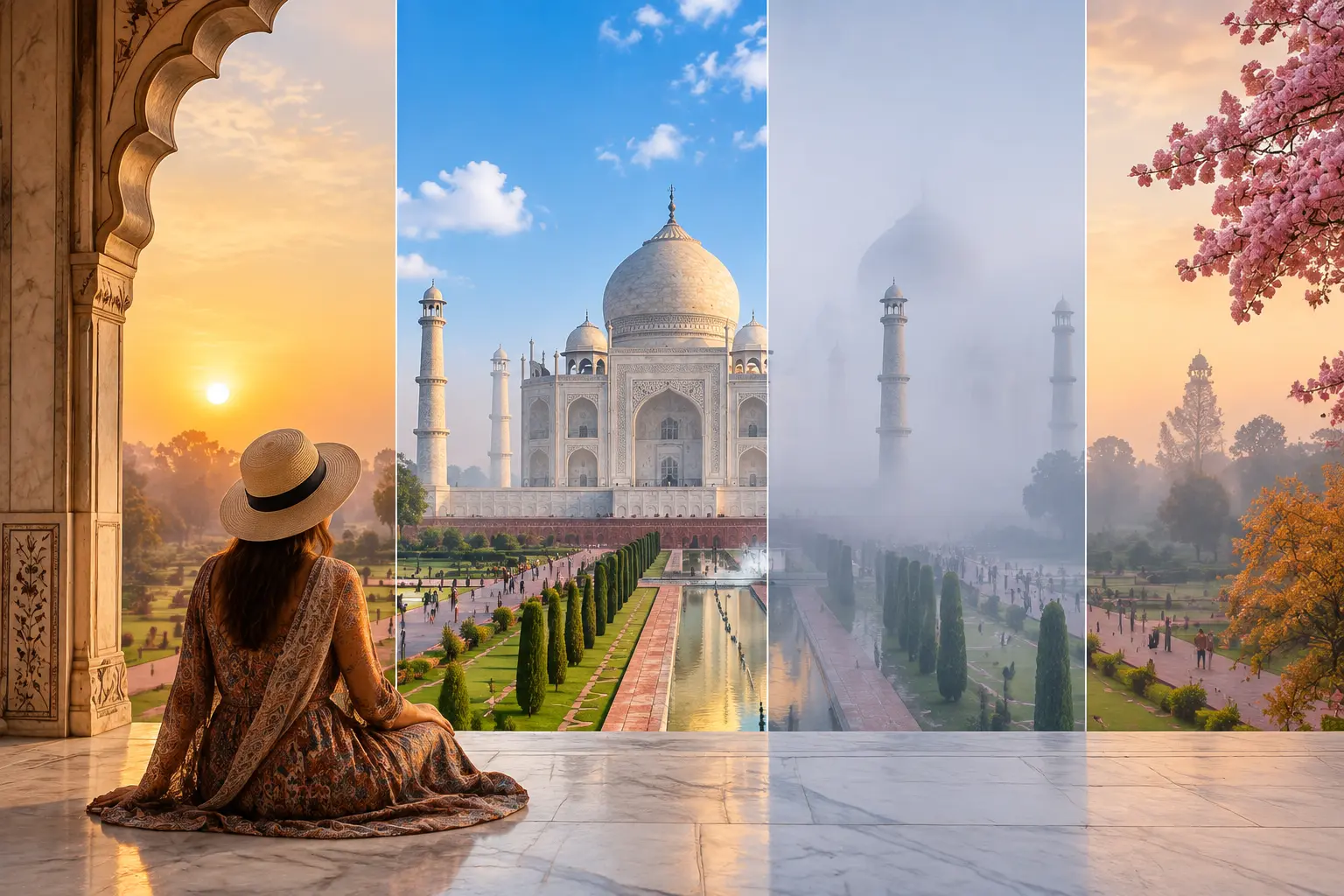
Agra doesn’t give you a bad visit. It gives you a foggy one, a scorching one, a crowded one, or the kind where the marble turns gold in the first light and barely anyone else is there. Which version you get depends almost entirely on when you go and what time you arrive at the gate.
Most travel guides tell you “October to March” and leave it there. But that six-month window contains multitudes. January mornings in Agra can be so thick with fog that the Taj Mahal is completely invisible until nearly 10:00 a.m. Meanwhile, a Tuesday morning in late November can give you the monument almost to yourself in clear, golden light. The difference between those two experiences is enormous, and the planning decisions that separate them are not complicated once you know what to look for.
The guide provides an honest month-by-month breakdown of Agra’s seasons, giving specific recommendations regarding sunrise times, crowd movements, and how to plan a visit that delivers results rather than just looking good on paper. Whether you’re joining a luxury Golden Triangle tour or arranging your whole India trip around a few days in Agra, the seasonal choices discussed here will have a major impact on most of your memories.
If you only have one shot at this, go in November.
The monsoon clears in October, and by November Agra’s weather has settled into something genuinely comfortable: daytime temperatures range from 15°C to 28°C, the air is clean, and there is that kind of early morning clarity which ensures a sunrise visit takes place as it should. The gardens within the Taj complex are still green because of the rainfall. Most mornings the sky is open and clear, and although the number of people is not small, they have not yet reached the peak seen between mid-December and January, which causes every ticketed entry queue to become twice as long as its usual length.
Late February is the other sweet spot. Temperatures sit around 22°C to 25°C. The Taj Mahotsav cultural festival (typically held in February near Shilpgram, close to the eastern gate) adds a craft, music, and food dimension that makes this an interesting time to be in the city beyond the monuments alone. And the fog that plagues December and January mornings is largely gone.
Between these two windows, more experienced India travelers consistently choose November. But late February, especially on a weekday, is equally rewarding and slightly less well-known.
Agra in October is at its most visually appealing after the monsoon, and the gardens within the Taj complex appear better than at any other time of year. The air in the mornings is fresh, and during the day the temperature ranges from 28°C to 30°C, which is warm but not oppressive. Domestic tourism increases, although the international number of visitors has not yet reached its peak. The month is truly underrated, particularly the second half when the temperatures further settle.
March is the final part of the favorable period, and it progresses rapidly; the first two weeks are still pleasant. The temperatures then rise quickly above 30°C, and the heat begins to have a real impact on the length of time you can spend walking in an exposed marble courtyard. However, in early March, especially when the sunrise-first approach is used, it still works well for the majority of tourists.
These are the most visited months in Agra. International travelers fill the heritage hotels. The Taj Mahal hits its highest visitor numbers. And hotel rates are at their annual peak.
But the aspect that most travel guides fail to mention is that dense radiation fog is a common phenomenon on the North Indian plains during December and January. It is caused by cold ground temperatures, light winds, and moisture rising from the Yamuna River. On a foggy morning in January, the dome of the Taj Mahal may be completely out of sight from the main entrance. Visitors who turn up at 06:00 a.m. may end up looking at a white blur for two hours before the monument gradually appears. This is by no means something that happens by chance; it occurs regularly and at times lasts for three or four days in a row. There are confirmed accounts from January 2025 stating that the Taj was entirely hidden by fog for three consecutive days.
However, this does not mean that December and January are bad options; the fog generally clears by mid-morning and the winter afternoon light is actually very good for photography. But you should plan the afternoon as a proper alternative rather than treating it as a secondary consideration. Avoid spending your only morning in Agra relying on a fog-free sunrise in January.
By May and June, temperatures regularly go above 40°C and at times reach 45°C in the afternoon. The marble courtyard of the Taj Mahal becomes a reflector of heat during this time. This makes it really uncomfortable to walk on it in thin shoes between 10:00 a.m. and 04:00 p.m.
Nevertheless, summer provides something no other season does: near-private access to one of the world’s most visited monuments. In April and May, the first 90 minutes after the gates open are exceptional, because the crowds are light, there is direct morning light falling on the white marble, and there is enough quietude within the complex to be able to hear one’s own thoughts. If you can get to the site before 07:00 a.m. and plan the rest of your day around indoor activities, then summer will work.
Midday is best spent in air conditioning, or at a marble inlay workshop through the Art and Craft Tour of Agra, where the craft itself justifies the time indoors. The Kachhpura Village Walk is much better suited to the late afternoon in summer, around 04:30 p.m., when temperatures drop, and the light on the Taj across the Yamuna turns warm rather than bleached.
In July and August, the rain is heavy, occurring mostly in short, intense bursts instead of in a continuous drizzle. The average amount of rainfall is about 211 mm in July and 225 mm in August, indicating that the conditions are truly wet and that the humidity is high. When enjoying outdoor attractions, it is best to be flexible. You must also be willing to arrange alternative indoor activities.
But. The Taj Mahal gardens in August are the greenest they get all year. The visitor numbers are the lowest of any season. Dramatic monsoon clouds create photographic conditions that simply don’t exist at any other time: dark skies behind white marble, the complex reflected in pools that catch the rain. September is the most practical month within this window as the rain tapers and humidity begins to ease, while still keeping the crowd advantages. It pairs well with a wider North India heritage tour before the October rush begins.
Go at sunrise. It’s not even close. The first 60 to 90 minutes after the gates open are the most rewarding window of the day for any season, any month. The light is softer. The temperature is at its lowest point of the day. And the crowds in that early window are a fraction of what arrives by 09:00 a.m. The Taj Mahal opens 30 minutes before sunrise, and the gate opening time shifts throughout the year: around 06:00 a.m. to 06:30 a.m. in winter, closer to 05:30 a.m. in peak summer. The East Gate is the right entry point for sunrise visits. Arrive 45 to 60 minutes before official opening to be at the front of the queue.
Those who want something quieter and more personal before the main visit can arrange a Taj Mahal-facing yoga session with a private instructor at dawn. It’s not for everyone, but those who do it tend to describe the hour very differently from any other Taj Mahal experience they’ve had.
There is one important exception to the sunrise rule: fog in December and January. If thick fog covers the Yamuna basin, a trip to see the monument at sunrise will not give you the experience it claims to. Although the sky will get lighter and the light will change, the monument may still be out of sight. If you are planning to visit during these months, look at the weather forecast for Agra the night before and be realistic about the possibility of fog. On mornings when there is fog, change your main visit to 10:00 a.m. or later when the fog has cleared, and use the morning hours instead for seeing the Agra Fort.
The view of the sunset from within the Taj Mahal complex is pleasant since the marble assumes warmer colors. However, it is more crowded than at sunrise, and the light varies greatly according to the haze. In fact, you can enjoy some of the best views of the Taj at sunset not from inside the complex, but from Mehtab Bagh (Moonlight Garden), where the monument is seen framed by the changing sky in a manner which the main complex does not permit. The Kachhpura Village Walk comes to an end here with a late afternoon stroll through the village and a sunset view of the Taj which most visitors never get.
The Taj Mahal is always closed on Friday, so that the mosque in the complex can be used for the Friday prayers. There is no alternative to this arrangement. It is consistently the most frequent mistake travelers make when planning short trips to Agra, especially when taking a weekend break from Delhi.
If your itinerary lands on a Friday in Agra, use the day for the three UNESCO World Heritage Sites that remain open: Agra Fort and Fatehpur Sikri are both excellent full-morning options. Itmad-ud-Daulah, known as the Baby Taj, is also open on Fridays. These are genuinely worthwhile sites in their own right, not consolation prizes.
Around five nights for each full moon, the Taj Mahal is open for night viewing as part of a special ticketed arrangement: the night of the full moon, the two nights before and the two nights after. A total of 400 visitors are allowed, divided into groups of 50, with each group having a strict 30-minute time limit for viewing. Tickets have to be bought 24 hours in advance at the Archaeological Survey of India office located at 22 Mall Road in Agra.
Night viewing is not offered on Fridays or during Ramzan, and if the full moon night falls on a Friday, then that night will be omitted altogether. It is advisable to book as early as possible during the peak season (from November through February) since the slots get filled within hours of opening.
The experience is actually quite different from that during the day: the marble gets a silvery appearance in the moonlight, the complex is almost entirely silent, and since there is a 30-minute time limit, the visit proceeds at a slow pace unlike the rare sense of slowness experienced during the day.
| Month | Temperature Range | Fog Risk | Crowd Level | Verdict |
| October | 20°C to 33°C | Low | Moderate | Strong choice |
| November | 15°C to 28°C | Very low | Moderate to high | Best overall |
| December | 9°C to 25°C | High | Very high | Fog risk; plan afternoon backup |
| January | 7°C to 22°C | Very high | Very high | Fog risk; highest crowds |
| February | 10°C to 25°C | Low to moderate | Moderate to high | Excellent choice |
| March | 13°C to 30°C | Very low | Moderate | Good early month |
| April to June | 20°C to 45°C | None | Low | Sunrise only |
| July to September | 27°C to 42°C | None | Very low | Flexible, lush, quiet |
Counter queues in November through January are long and can add an hour or more to your morning. Book through the official ASI ticketing portal or through authorized channels before you arrive.
Tuesday through Thursday in shoulder months (October, February, March) offer the best combination of good weather and manageable visitor numbers.
Gate opening times shift by more than 90 minutes across the year, and arriving at the wrong time is a surprisingly common mistake.
For those staying in Agra rather than visiting as a day trip, the Oberoi Amarvilas sits 600 meters from the Taj Mahal with direct monument views from every room. A pre-dawn start from there involves a five-minute walk rather than a cross-city car journey, which makes a meaningful difference when your alarm goes off at 05:00 a.m.
For a broader trip connecting Agra with Delhi and Jaipur, the private tailor-made India tours by Bespoke India Holidays are structured so Agra falls on weekdays and the Taj Mahal visit is always the fixed anchor point for the day, with everything else built around it. Those extending beyond the triangle often combine Agra with Ranthambore for a tiger safari or fold in Varanasi for the Ganges ghats as part of a wider North India tour.
November is the best month for a visit to the Taj. Clear skies, comfortable temperatures between 15°C and 28°C, and crowds that are high but not yet at their December-January peak. Late February is a close second.
Yes, the fog does affect the views of the Taj in winter. Dense radiation fog is a regular feature of December and January mornings across the North Indian plains. On affected days, the Taj can be invisible from the main gate until 10:00 a.m. or later. Check forecasts the night before and plan accordingly.
In October, November, February, and March: consistently yes. In December and January: only if the forecast is fog-free. In summer: yes, but only if you leave before 09:30 a.m.
The Taj Mahal is closed every Friday. Use the day for Agra Fort, Fatehpur Sikri, or Itmad-ud-Daulah. The Art and Craft Tour of Agra is also an excellent Friday option.
Visiting Agra and the Taj Mahal during the monsoons, especially in September, is definitely worth considering. The rain tapers during this month, the gardens look their best, crowds are at their lowest, and hotel rates drop significantly. July and August require more flexibility due to heavier rainfall.
Our travel experts are here to help you craft the perfect itinerary — stress-free and tailored just for you.
Contact Our Travel Experts
Munnar earns its reputation quietly. There are no major cities nearby. No heritage monuments to queue for. What draws visitors…
The best 2-week India travel itinerary for first-time visitors covers the Golden Triangle (Delhi, Agra, Jaipur), extends into Rajasthan or…
What does it take for a walk in the clouds? You heard it right. A walk in the clouds, along…
By:Acodez Web
September 7, 2026
Delhi is the introduction, not the story. Beyond the boundaries of Mughal architecture and modern cosmopolitanism, is the bigger story, made of many parts that…
Read Post
By:Bespoke admin
July 25, 2020
“Sat Sri Akaal” means “Truth is the name of God”, you will always be greeted by a “Sat Sri Akaal” when in Amritsar Punjab. Home…
Read Post
By:Acodez Web
October 8, 2026
A luxury Rajasthan tour needs at least a week, but 10 to 14 days gives you enough time to enjoy the state without rushing from…
Read Post