
Best Places to Visit in Delhi: Old Delhi, New Delhi & Beyond
Published on : September 7, 2026
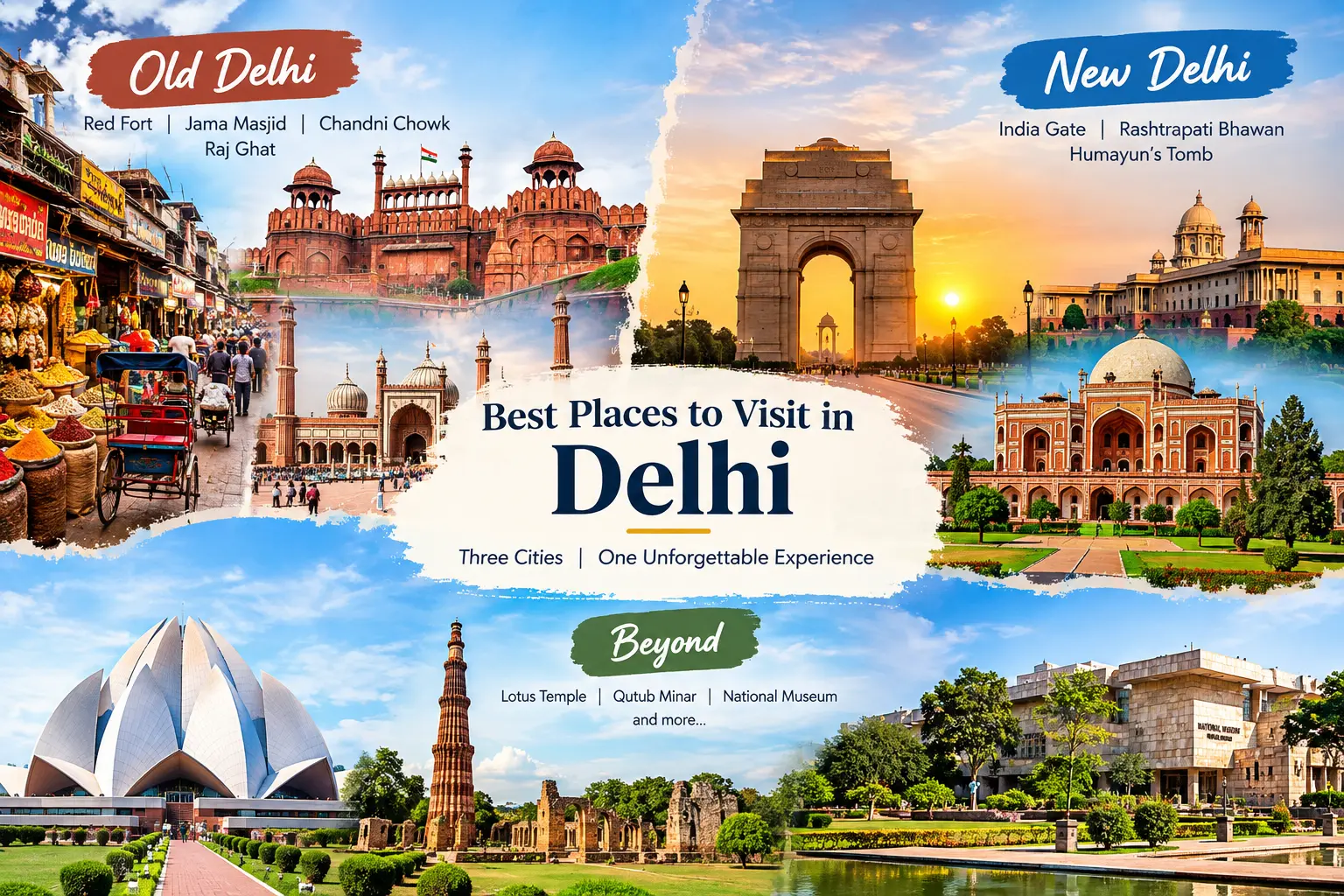
Delhi, the heartbeat of India, doesn’t fit neatly into a single postcard. Not one, but in reality, it’s three cities wearing one name. Old Delhi, the walled Mughal capital where the streets still smell like cardamom infused jalebis. New Delhi, which is the British-planned grid of wide avenues and government buildings. And then there’s a growing modern metropolis beyond both. All three happen to hold some of the best places to visit on your Delhi trip.
All you need is to know how they fit together. We have sorted Delhi into three zones that actually make sense of the city. If you’ve got more time to give it and keep going, our 2-week India travel itinerary is all set for you.
If you only have one afternoon in Delhi, spend it here. Old Delhi gets under your skin fast. Built in the 1600s by Mughal Emperor Shah Jahan, this part of the capital city reflects narrow streets called galiyaan, historic Islamic architecture, and a rich history.
Nearly 200 years of Mughal power lived behind these walls, and the 2.5-kilometer sandstone perimeter around marble halls that once glittered with gems still shows why. Built between 1638 and 1648 along the Yamuna River basin, the red sandstone citadel is a UNESCO World Heritage Site.
As you step through the Lahore Gate into the Chhatta Chowk (a historic covered bazaar), you follow in the footsteps of royal court artisans. Don’t miss the Diwan-i-Aam (Hall of Public Audience) and the beautiful white marble Diwan-i-Khas (Hall of Private Audience).
Bespoke India Holidays arranges early-morning private guided access with a senior historian. You’ll have the courtyards nearly to yourself, and the light is better for photos anyway.
Just a short walk from the Red Fort lies Shah Jahan’s final architectural legacy: the Jama Masjid. Built by over 5,000 artisans, it’s one of India’s largest mosques with a central courtyard for 25,000 worshippers. It is built with alternating vertical strips of red sandstone and white marble. Climb up the narrow staircase of the southern minaret for a beautiful panoramic view of Old Delhi’s dense rooftops.
From there, a cycle-rickshaw through Chandni Chowk takes you past spice markets and jewelry shops that have belonged to the same families for generations. Give yourself some time, and don’t leave without a stop in Parathe Wali Gali. Try hot stuffed parathas fried in pure ghee, chaat, and the evergreen jalebi.
Raj Ghat is on the quieter edge of Old Delhi, a simple black marble platform that marks the cremation site of Mahatma Gandhi. It’s a brief stop, but one that tends to stay with visitors longer than almost anywhere else on this list.
While Old Delhi feels layered and chaotic in the best way, New Delhi feels planned, and it was. British architects Sir Edwin Lutyens and Sir Herbert Baker built it in the early 20th century as their imperial capital. Lutyens’ Delhi is defined by wide ceremonial avenues designed to impress. Today it’s home to some of the most famous places in Delhi, several of which are far older than the city around them.
Time your visit to India Gate for the evening. Honoring more than 70,000 soldiers of the British Indian Army who lost their lives in World War I, the 42-meter war memorial looks its best at the golden hour. Monuments light up, the crowd is much smaller than the daytime, and the entire stretch photographs beautifully.
The lawns along the Kartavya Path bring you face-to-face with the civic pride of modern India. With families sitting by the illuminated arch, food carts, surrounding fountains, boat rides on the nearby ponds, and an easy energy as the sun sets, it all feels peaceful.
With a short drive along the path, at the western end of the avenue, you’ll pass the Rashtrapati Bhavan (the Official Residence of the President of India). Spread over 330 acres, this 340-room mansion reflects a blend of classical European colonnades with Indian architectural motifs such as chhatris and jaali screens.
Humayun’s Tomb doesn’t get nearly the crowds it deserves. Just south of central New Delhi, this first garden-tomb of India was built in 1570 within Charbagh (four-fold Persian style) gardens. Its red sandstone geometry, double dome structure, and white marble directly inspired the design of the Taj Mahal a century later. UNESCO’s official listing confirms its inscription in 1993. Once you’ve seen it, you’ll understand why it’s a must visit place in Delhi.
Beyond the main Tomb, the restored Nizamuddin Heritage Zone features Sundar Nursery, an eco-restoration marvel housing 300+ tree species and 16th-century monuments.
New Delhi’s modern side deserves a look too. Resembling a blossoming white lotus flower, this award-winning Bahá’í temple stands among some of the really cool places to visit in Delhi. Designed by Iranian-Canadian architect Fariborz Sahba, the structure consists of 27 free-standing marble-clad ‘petals’ arranged in clusters of three. It is open to people of all faiths. Its serene interior, surrounded by nine crystalline blue ponds, offers a contemplative space free of religious icons.
While the Lotus Temple embraces minimalism, Akshardham goes in the opposite direction entirely, with maximalist carved stone and musical fountains (Sahaj Anand Water Show) that light up after dark. It was built entirely without structural steel, yet features 20,000 carved deities and sculpted elephants crafted from pink sandstone and Italian Carrara marble.
Also visit the National Museum, home to artifacts from the Indus Valley Civilization through the Mughal era, just in case you’re interested in India’s deep-rooted history.
One of those places worth visiting in New Delhi is the Lodhi Art District. It is India’s first open-air public art gallery, a beautiful street of artwork between Khanna Market and Meherchand Market. Over 50 murals have transformed this residential government neighborhood into a colorful canvas. Painted by renowned street artists from around the globe, the murals reflect themes ranging from climate change and women empowerment to Indian folklore.
Gurudwara Bangla Sahib is the most prominent Sikh house of worship in Delhi, known for its gleaming golden domes and large sacred pool.
Beyond its peaceful spiritual ambiance, the highlight for visitors is witnessing the Langar: a community kitchen where volunteers prepare and serve free, hot vegetarian meals to over 30,000 people daily, regardless of caste, creed, or background. Participating in or observing this selfless service (Sewa) is often voted by our guests as one of the most moving experiences in India.
Some of the best places to go in New Delhi and the wider capital sit a little outside the usual tourist loop, and they’re worth the extra hour in the car. Yes, that’s South Delhi for you.
With 73 meters of carved red sandstone, Qutub Minar is the tallest brick minaret in the world. It was constructed in 1192 by Qutb-ud-din Aibak after the fall of the last Hindu kingdom in Delhi and it marks the dawn of Indo-Islamic architecture in India.
Beside it stand the ruined Quwwat-ul-Islam Mosque and the famous 7.2 meters tall Iron Pillar, built in the 4th century CE under King Chandragupta II, which has somehow defied atmospheric corrosion for over 1,600 years.
Humayun’s Tomb is one of Delhi’s most-visited monuments, as confirmed by Delhi Tourism’s own heritage records.
Hauz Khas Village is where Delhi’s past and present sit at the same table, literally. Where else in the world can you sip craft cocktails at a rooftop café or browse boutique fashion over 14th century Sultanate-era ruins of a madrasa.
Round it out with Dilli Haat, an open-air crafts market where every Indian state gets a stall for its artisans to sell directly. Not only that, regional food stalls alongside represent half the country under one roof.
If your trip lines up with a Thursday, go to Nizamuddin Dargah after dark. Live Sufi qawwali has filled this shrine for more than 700 years, and it’s one of those experiences you can’t plan for on a checklist; you have to be there.
In case you have an extra day, the Taj Mahal in Agra is a comfortable day trip from Delhi by car. Our Golden Triangle itinerary through Agra and Jaipur pairs beautifully if you can spend a few more nights.
With Bespoke India Holidays, you can also request luxury trains that operate like nothing but five-star hotels on wheels. Mid-range options are available at $250-350 per person per day, while the luxury ones cost more.
Reading about Delhi is one thing. But actually moving through it, fitting three very different zones into one trip, without burning half your day in traffic or standing in line at the wrong time, is a different skill entirely.
It’s the one thing we’ve spent years getting right at Bespoke India Holidays. Our Design Your Trip tool understands your preferences and connects you to a National Tourism Award-winning travel advisor within 48 to 72 hours who builds the right plan for you.
Every trip you take with us includes a private vehicle, driver, and a guide who know the real stories behind the city. India travel tips also help with the visas, packing, and everything else you should know first.
We recommend spending 2 to 3 days in Delhi. This allows ample time to comfortably explore Old Delhi’s heritage sites, New Delhi’s imperial monuments, and modern cultural spots like Lodhi Art District without feeling rushed.
Between October and March is the best time to visit Delhi. During autumn and winter, daytime weather is sunny and crisp, perfect for in-city walks and shopping. April to June can be extremely hot, while July through September brings monsoon rains.
Yes, Delhi is very safe, especially when you’re travelling with a reputable luxury tour operator like Bespoke India Holidays. We provide private air-conditioned luxury vehicles, professional vetted chauffeurs, and dedicated expert tour guides throughout your journey.
Booking a private car with a driver is by far the easiest option, since these three areas are farther apart than they look on a map.
Our travel experts are here to help you craft the perfect itinerary — stress-free and tailored just for you.
Contact Our Travel Experts
Oberoi Amarvilas: A Palace Overlooking Another Located just 600 meters from the greatest ever monument to love, Oberoi Amarvilas is…

“God’s Own Country,” that’s how locals call this land. Spend three days here, and you’ll stop thinking of it as…
White water rafting is not for the chicken-hearted. If that sounds like a let down for some, the good news…
By:Acodez Web
September 30, 2026
Kerala is usually pictured as backwaters and beaches. Ask anyone who has actually spent time in the state’s hills, and the story changes its character.…
Read Post
By:Acodez Web
September 23, 2026
January in Jaipur looks different from any other time of year. The forts are the same. The bazaars are the same. But for five days…
Read Post
By:Acodez Web
September 9, 2026
Delhi’s summer heat can make a quick break to the mountains feel especially appealing. Mussoorie, Nainital, Kasauli and Lansdowne are among the best hill stations…
Read Post