
Ranthambore or Bandhavgarh: Which Tiger Reserve Is Better for a Wildlife Safari?
Published on : October 6, 2026
Deciding between Ranthambore or Bandhavgarh is one of the most common questions US travelers ask when planning a wildlife safari in India. It is perfectly possible to see a wild tiger in either of the two reserves. In both places you can find luxury camps, expert naturalists, and the kind of early morning game drive which remains with you for years after the trip. Nevertheless, there are real differences in their character, and it is a risk worth taking seriously to select the wrong one according to your travel needs. The guide presents the comparison in an honest way so that you can decide before making a booking.
The short version of the Ranthambore vs Bandhavgarh decision: Ranthambore is more easily accessible, better incorporated into the cultural network of Rajasthan, and provides far greater opportunities for dramatic landscape photography than Bandhavgarh can. Although Bandhavgarh has a higher tiger density and a more wooded atmosphere, for those whose only aim is to maximize their chances of seeing a tiger, it is the better option. The right choice depends on knowing what is most important to you.
It is important to note that neither reserve guarantees you a tiger sighting. Wildlife is rather unpredictable. So, you could complete six game drives at either reserve and still see nothing. That said, both carry sighting probabilities well above 50 percent over a multi-drive visit, especially during the right season. Also, experienced naturalists at the best camps improve that probability considerably. Planning around sighting season, booking the right zones, and spending enough nights at the reserve are the three decisions that matter most to the Ranthambore vs Bandhavgarh safari experience.
This guide covers every relevant variable for the Ranthambore vs Bandhavgarh wildlife safari decision: reserve size and tiger density, accessibility, landscape and photography, luxury accommodation at each, sighting zones, season, and how each fits into a wider India itinerary.
| Factor | Ranthambore | Bandhavgarh |
| Location | Rajasthan (Sawai Madhopur district) | Madhya Pradesh (Umaria district) |
| Reserve size | 1,334 sq km (core + buffer) | 1,536 sq km (core + buffer) |
| Core zone size | 392 sq km | 105 sq km (Tala zone) |
| Tiger population (approx.) | 70 to 80 tigers | 115 to 130 tigers |
| Tiger density | Moderate to high | Highest in India |
| Sighting probability (Oct to March) | 50 to 65% per drive | 65 to 80% per drive (Tala zone) |
| Nearest airport | Jaipur (IAI), 180 km | Jabalpur (JLR), 165 km |
| Safari zones | 10 zones (1 to 10) | 3 core zones (Tala, Magdhi, Khitauli) |
| Landscape character | Open grassland, lakes, 10th-century fort | Dense sal forest, bamboo, ancient ruins |
| Park open season | October to June (closed July to September) | October to June (closed July to September) |
On the core question of the Ranthambore vs Bandhavgarh wildlife safari decision, Bandhavgarh holds the edge. Its Tala zone, the primary tourism zone, covers roughly 105 square kilometers with an estimated density of more than one tiger per 10 square kilometers. That concentration means sightings are more frequent and often more prolonged than at Ranthambore. At Bandhavgarh, it is not unusual for a single game drive to produce multiple tigers, including cubs, and to spend 30 to 45 minutes with one animal in a single session. Recent lodge naturalist logs from the Tala zone report sighting rates above 80 percent during the October to June season.
Ranthambore has a strong tiger population of 70 to 80 individuals across a larger and more open reserve. The sighting rate across its best zones (Zones 2, 3, and 6) runs at roughly 50 to 65 percent per drive. The tigers at Ranthambore are more accustomed to vehicle presence in some zones, which can produce long, relaxed sightings when they do happen. The open terrain also means you can often see a tiger from greater distance, which produces a different visual experience from Bandhavgarh’s dense forest encounters. In the Ranthambore or Bandhavgarh which is better comparison for pure sighting frequency, Bandhavgarh leads. For dramatic, open-landscape sightings with the reserve’s 10th-century fort as backdrop, Ranthambore produces images that no other Indian reserve can replicate.
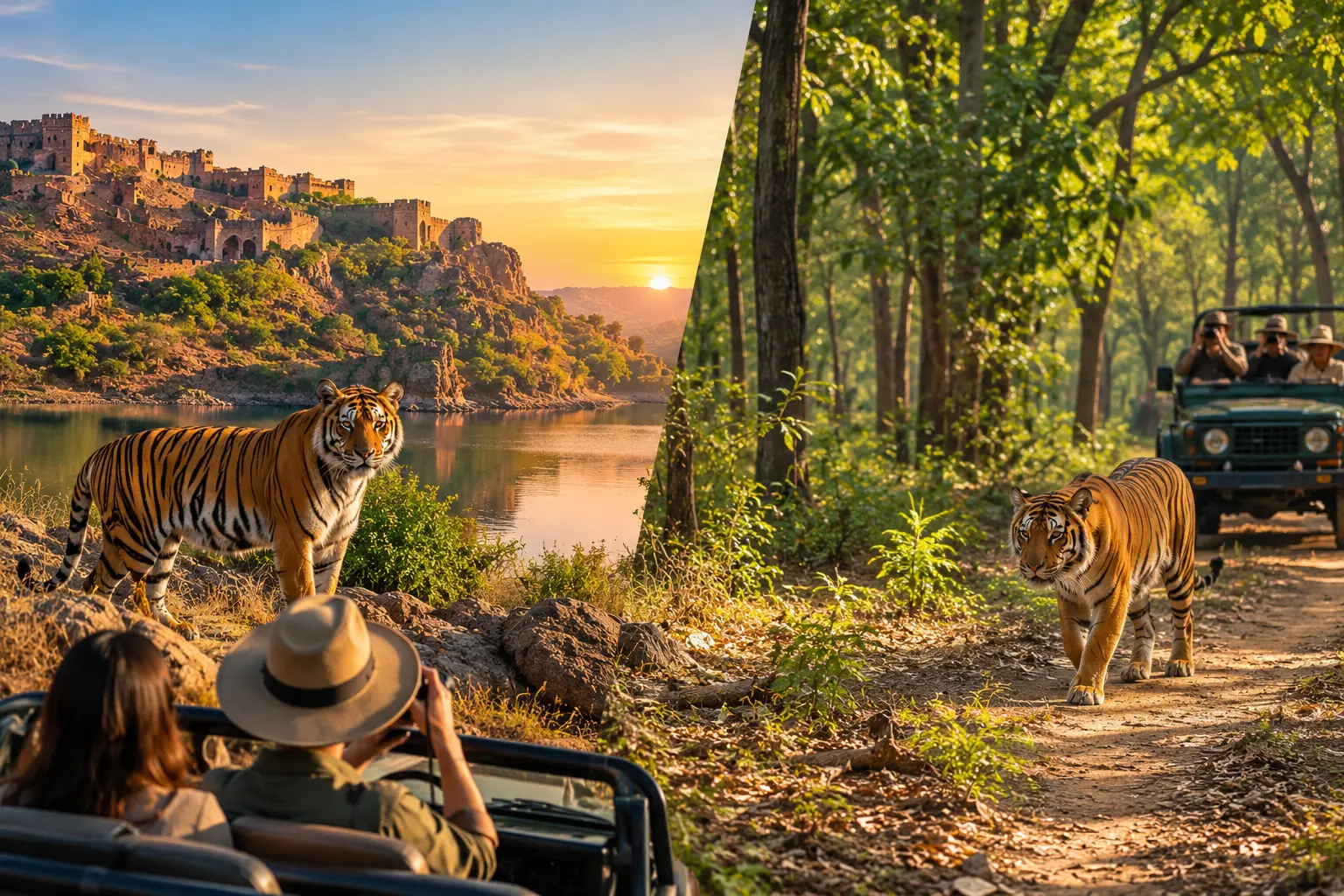
The landscape difference between Ranthambore or Bandhavgarh is the most underestimated factor in the comparison. Ranthambore’s terrain is dramatically open. Dry deciduous forest opens onto lakes, grasslands, and rocky outcrops. The 10th-century Ranthambore Fort, a UNESCO World Heritage Site, rises above the core zone and creates one of the most distinctive wildlife photography backdrops in Asia. A tiger crossing a lake edge with the fort in the background is a specific image that photographers return to Ranthambore repeatedly to attempt. Visibility across the open terrain means you often see animals at long range and can track their movement through the landscape.
The thick sal and bamboo forest at Bandhavgarh offers a completely different kind of photographic opportunity, with encounters being closer, more intimate, and more immersive. The canopy of the forest filters the light in a manner that is well-suited to wildlife photography using longer lenses. Throughout the Tala area, there are ancient caves and ruins, such as the historic Bandhavgarh Fort, and the atmosphere of the reserve seems more ancient and confined. Those who have experienced both the Ranthambore vs Bandhavgarh safari experience consistently say that Ranthambore has a cinematic and extensive character, while Bandhavgarh feels intimate and deeply rooted in the forest. Neither of these descriptions is a criticism. They simply reflect the genuinely different experiences.
Zone selection is one of the most practically important variables in the Ranthambore vs Bandhavgarh comparison, and it is where many travelers lose sighting probability through uninformed booking.
There are 10 safari areas in Ranthambore. The core areas, numbered 1 to 5, have the highest historical rate of sightings. Particularly in zones 2, 3 and 6, there have been several resident tigresses whose territorial behaviour is well known to the guides. Zone 3 includes the lake area and the route leading to the fort, and it is here that the majority of photographed sightings in Ranthambore take place. Zones 7 through 10 are buffer zones with a lower frequency of sightings but with easier access to permits. When booking, make sure to request the core zones. The permit system for Ranthambore National Park becomes available online 120 days in advance. Permits for the core zones are allocated within hours during the peak season. Although your luxury camp will carry out the booking, you should still confirm that they are asking for a core zone allocation.
Bandhavgarh operates three core tourism zones: Tala, Magdhi, and Khitauli. Tala is the main area and has the greatest tiger density and the highest number of tiger sightings. Although Magdhi and Khitauli have good wildlife, the number of sightings in these areas is lower. You should book for the Tala zone. The permit website operated by the Madhya Pradesh forest department is in charge of arranging bookings for Bandhavgarh, and bookings become available 120 days in advance. Permits for the Tala zone are the most competitive within the system. Those camping with permits that have been assigned to the Tala zone are the best option. Make sure to check this point before booking your accommodation.
Ranthambore has the strongest luxury accommodation of any Indian tiger reserve. Oberoi Vanyavilas sits on 20 acres of landscaped gardens 10 minutes by Jeep from the park entrance. Its 25 air-conditioned tents, each 790 square feet, have teak floors, four-poster king beds, freestanding baths, and private garden decks with butler service. There is a temperature-controlled swimming pool, a full-service spa, an observation tower over the park edge, and a menu drawing from the camp’s own kitchen garden. The evening conservation talks by resident naturalists are among the best in India. Rates start around $780 to $885 per tent per night in peak season.
Aman-i-Khás is the ultra-luxury alternative: ten Mughal-inspired tents with personal butlers, private dining, and guided safaris designed around your photography or sighting preferences. Rates start well above $1,500 per night. SUJÁN Sher Bagh offers a 1920s safari camp aesthetic with 12 tents, strong naturalist guiding, and a more intimate atmosphere than either Oberoi or Aman.
Bandhavgarh’s luxury accommodation tier is smaller but strong. Oberoi Vindhyavilas, the newest Oberoi wildlife property, offers tented villas minutes from the Tala zone with the same service standard as Vanyavilas at Ranthambore. Rates are comparable. Mahua Kothi, a Taj Safaris property, sits in the Tala buffer zone with 12 Kutiya-style cottages, bush dinners, and naturalist walks alongside the standard game drives. The intimate scale of both properties suits the forest character of the reserve better than a larger hotel would.
| Property | Reserve | Type | Approx. Rate | Best For |
| Oberoi Vanyavilas | Ranthambore | Tented camp, 25 tents | $780 to $900/night | Full-service luxury, conservation talks |
| Aman-i-Khás | Ranthambore | Ultra-luxury camp, 10 tents | $1,500+/night | Maximum privacy and personalization |
| SUJÁN Sher Bagh | Ranthambore | Heritage safari camp, 12 tents | $600 to $800/night | 1920s aesthetic, strong naturalists |
| Oberoi Vindhyavilas | Bandhavgarh | Tented villas | $750 to $900/night | Oberoi service, Tala zone proximity |
| Mahua Kothi | Bandhavgarh | Kutiya cottages, 12 units | $400 to $600/night | Forest immersion, intimate scale |
Accessibility is one of the clearest practical differences in the Ranthambore or Bandhavgarh comparison. Ranthambore sits 180 km from Jaipur, roughly a three to four-hour drive by private car. It connects naturally to a Rajasthan luxury itinerary as a two or three-night extension after Jaipur. For US travelers on a Golden Triangle route, Ranthambore slots in between Jaipur and Udaipur or as the final stop before flying out of Jaipur. It requires no additional domestic flight and no itinerary restructuring.
Bandhavgarh is in Madhya Pradesh, roughly 165 km from Jabalpur airport. Getting there from Jaipur or Delhi requires a domestic flight to Jabalpur followed by a three to four-hour drive. That is entirely manageable, but it adds a flight segment and a half-day of transit to the itinerary. Most travelers who choose Bandhavgarh are either building a dedicated wildlife circuit, or they are combining it with Kanha for a two-reserve Madhya Pradesh safari. If your India trip includes Rajasthan as the primary focus, Ranthambore is the more practical choice purely on itinerary logistics. If the safari is the primary focus of the trip and heritage is secondary, Bandhavgarh’s superior sighting probability justifies the added transit.
For travelers wanting to combine both reserves on a single trip, our team at Bespoke India Holidays designs dedicated wildlife circuits that sequence Ranthambore, Bandhavgarh, and Kanha into a 10 to 12-day itinerary with domestic flights between the reserves. This is the strongest format for serious wildlife travelers who want maximum sighting probability across different reserve environments.
Both reserves operate on the same seasonal calendar: open October to June, closed July to September during the monsoon. But the Ranthambore vs Bandhavgarh safari experience shifts significantly within that window depending on when you visit.
| Season | Months | Ranthambore Conditions | Bandhavgarh Conditions |
| Cool season (best overall) | October to February | Cool mornings, 10°C to 25°C, comfortable drives, strong sighting rates | Similar conditions, forest is dense, good sightings in Tala zone |
| Summer (best sighting rates) | March to June | Hot (35°C to 42°C), but tigers concentrate at water bodies, sighting rate climbs above 70% | Very hot (38°C to 46°C), highest tiger sighting rates (above 85% in Tala), fewer visitors |
| Monsoon (closed) | July to September | Park closed | Park closed |
October through February is the most comfortable window for most US travelers. November and December offer the best balance of good weather, strong sighting rates, and comfortable safari conditions. March through May sees temperatures climb significantly, but both reserves reward the discomfort with the highest sighting probabilities of the year. Tigers congregate at the few remaining water sources, and sightings at waterhole locations can be long and intimate. If summer heat is manageable for you, the sighting rates during April and May make this the strongest Ranthambore vs Bandhavgarh wildlife safari window at both reserves.
The honest answer to Ranthambore or Bandhavgarh which is better is that it depends on which factor you weigh most heavily. Use the framework below:
Our team at Bespoke India Holidays has placed travelers at both reserves across many years. We handle permit bookings, zone allocation, luxury camp selection, and the domestic flight logistics that connect the two. Whether you choose one reserve or combine both, a properly planned India wildlife tour is the difference between a sighting you experience and one you spend three days waiting for. India’s tiger reserves are extraordinary. The planning that surrounds them determines whether the safari lives up to that.
Bandhavgarh’s Tala zone has higher sighting rates, typically 65 to 80 percent per drive during peak season, compared to Ranthambore’s best zones at 50 to 65 percent. However, both reserves offer strong sighting probability when you book the right zones and visit during October through June. The Ranthambore vs Bandhavgarh safari experience difference is more about frequency and forest character than simply sighting rates.
A minimum of two nights gives you four game drives (two morning, two evening). Three nights, giving you six drives, is the recommended minimum for the best probability across both reserves. Most luxury camps recommend arriving the evening before your first full safari day. At Ranthambore, four nights is ideal if you want multiple zone experiences. At Bandhavgarh, three nights focused on the Tala zone is the most efficient use of time.
Ranthambore is considerably easier from Delhi. It is accessible by private car via Jaipur (about 5 to 6 hours total), with no domestic flight required. Bandhavgarh requires a domestic flight from Delhi to Jabalpur (roughly 1.5 hours) followed by a 3 to 4-hour drive. For travelers basing their trip in Rajasthan, Ranthambore is the natural choice.
October through February for comfortable conditions. March through June for maximum sighting probability at both reserves, particularly at waterholes as temperatures climb. Summer safaris are hot but rewarding. Both parks are closed July through September during the monsoon.
Yes. A dedicated India wildlife tour combining both reserves takes 10 to 12 days with a domestic flight from Jaipur to Jabalpur between them. Adding Kanha to the circuit is a natural extension. Our team at Bespoke India Holidays designs multi-reserve wildlife itineraries covering the full logistics and permit booking for both parks.
Our travel experts are here to help you craft the perfect itinerary — stress-free and tailored just for you.
Contact Our Travel Experts
Planning a honeymoon trip in India gives couples far more choice than a single beach escape. You can stay in…
All the Incredible India Tour packages are meant to provide visitors with an opportunity to enjoy fantastic experiences of surprise,…
The magical land of Rajasthan, the northern desert state of India, beckons everyone to leave all the trappings of modern…
By:Bespoke admin
April 18, 2010
Kerala Ayurveda It’s an irony of the times we live in, which is little appreciated, though taken for granted: Alternative medicine is today main-stream and…
Read Post
By:Bespoke admin
September 5, 2014
India is home to some of the top luxury hotels in the world, offering memorable holidays, beautiful honeymoons, and amazing family trips across its culturally…
Read Post
By:Acodez Web
October 8, 2026
A luxury Rajasthan tour needs at least a week, but 10 to 14 days gives you enough time to enjoy the state without rushing from…
Read Post