
25 Interesting Facts About the Taj Mahal in Agra You Should Know
Published on : September 3, 2026
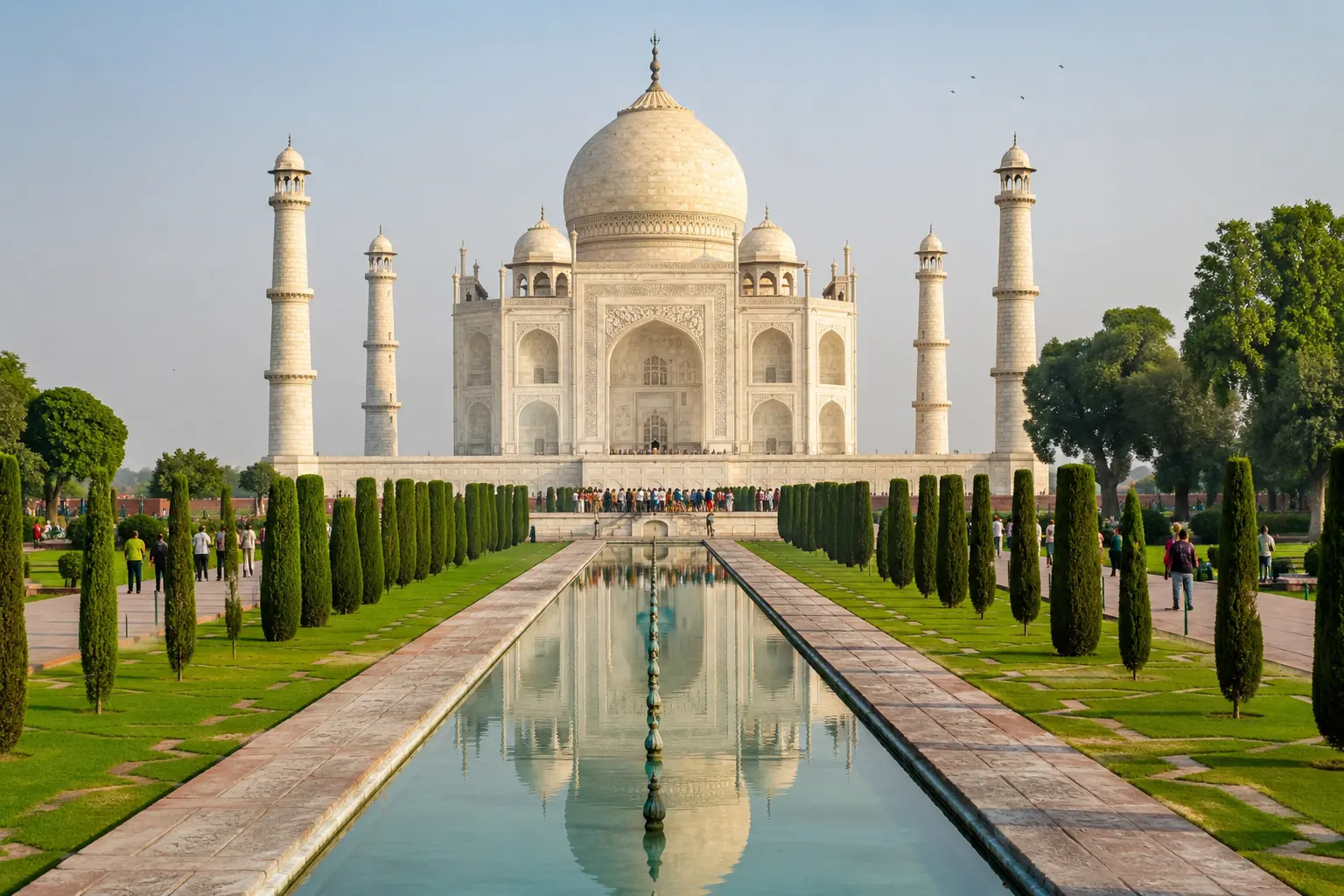
Most people think they already know the Taj Mahal. They have seen the photos and read about the love story. But standing in front of it is different. And understanding what went into building it is different still.
This is not just a monument. It is a 22-year construction effort involving tens of thousands of workers and layers of symbolism you would never catch in a single visit. Before you go, or even if you have already been, these 25 facts give you a much clearer picture of what you are actually looking at.
The Taj Mahal is a mausoleum. Emperor Shah Jahan commissioned it after the death of his wife, Mumtaz Mahal, in 1631. She died giving birth to their fourteenth child. The central structure was designed specifically as her burial place.
Shah Jahan was not originally supposed to be interred at the Taj Mahal. He was later imprisoned by his own son, Aurangzeb, and died in captivity. He was buried beside Mumtaz Mahal, which is why the interior is not perfectly symmetrical. His cenotaph sits slightly off-center from hers.
The main mausoleum was largely complete by 1648. The surrounding structures, such as the gardens, gateway, mosque, and guesthouse, took a few more years, and were completed around 1653. The entire project spanned roughly 22 years.
The workforce included marble sculptors, stone-inlay artists, calligraphers, dome specialists, garden designers, and general laborers. Workers came from across India, Persia, Central Asia, and the Ottoman Empire.
There was no modern machinery. Historical accounts suggest more than 1,000 elephants hauled heavy marble blocks and precious stones across northern India to the construction site in Agra.
Mumtaz Mahal died in Burhanpur, in present-day Madhya Pradesh. The original plan was to build the monument there. But Burhanpur could not supply enough white marble, so the project was moved to Agra.
Shah Jahan reportedly spent around 32 million rupees on the project. In today’s terms, that figure is estimated at close to USD 1 billion.
The translucent white marble used throughout the Taj Mahal was quarried in Makrana, Rajasthan, roughly 300 kilometers from Agra. Makrana marble is still considered among the finest in the world.
Each minaret tilts slightly away from the central tomb. If an earthquake were to bring one down, it would fall outward rather than onto the mausoleum. Most visitors never notice this detail.
The Taj Mahal sits on wells filled with stone and timber. Timber weakens over time, but the Yamuna River keeps the wood moist and structurally sound. Without the river, the foundation would likely have failed centuries ago.
The iconic onion-shaped dome is one of the largest Mughal domes ever built. A finial tops it, blending Islamic and traditional Indian design elements, including a crescent shape that, from certain angles, resembles a trident.
The full complex includes the main tomb, entrance gateway, mosque, guesthouse, formal gardens, water channels, and an outer courtyard. Most visitors focus only on the mausoleum and miss the rest.
By approximately 5 feet, the Taj Mahal clears the height of Qutub Minar in Delhi. This surprises most visitors who think of Qutub Minar as the taller structure.
Quranic inscriptions run across the main gateway and the mausoleum walls. The letters are actually larger higher up. This was intentional. From ground level, they appear to be exactly the same size throughout.
As you walk toward the Taj Mahal through the main gateway, the monument appears to grow larger. As you walk away, it seems to shrink. This perspective effect was engineered into the design.
At sunrise, the marble takes on a soft pink tone. By mid-morning, it turns bright white. At sunset, it shifts to golden. Under a full moon, it appears silvery blue. This is not a trick of the eyes but a result of how Makrana marble responds to light.
The walls use a technique called pietra dura, where cut and polished stones are set directly into marble. The stones include jade, crystal, turquoise, lapis lazuli, carnelian, jasper, sapphire, agate, and onyx, many of which were imported from Tibet, Sri Lanka, Persia, Afghanistan, and China.
The monument appears perfectly symmetrical, but each floral carving carries subtle differences. The artisans never duplicated their work exactly, reflecting their skill.
Following Islamic artistic tradition, the Taj Mahal contains no statues or carvings of people. The decoration is entirely composed of floral motifs, geometric patterns, and calligraphy.
Amanat Khan Shirazi was responsible for the Quranic inscriptions. His signature appears in the calligraphic work, making him one of the few individually named contributors to the project.
Inside the main chamber, you will find two elaborately decorated cenotaphs. These are symbolic memorials, not the actual graves. The real burial chambers for Mumtaz Mahal and Shah Jahan lie in a lower level beneath the main floor, in keeping with Islamic burial customs.
The garden is divided into four sections following the charbagh layout, a traditional Persian and Islamic design concept. The four parts, separated by water channels, represent the gardens of paradise described in the Quran.
During World War II and the 1971 Indo-Pakistan War, the Archaeological Survey of India covered the Taj Mahal with scaffolding to make it appear as a bamboo stockpile from the air, protecting it from aerial attack.
There is an active mosque within the complex. It closes every Friday for prayers. Many visitors arrive without knowing this, so plan your trip on any other day.
The Taj Mahal opens for night visits on the full moon and the two nights before and after. Each visit lasts about 30 minutes. Book tickets in advance. Seeing the marble under moonlight is a completely different experience from a daytime visit.
Visiting hours to the Taj run from sunrise to sunset, which is roughly between 06:00 a.m. to 07:00 p.m. Entry for international visitors is USD 13.
October through March is the best time to visit. Mornings are cooler, and the light is better for photography. December and January can bring fog around Agra, which may reduce visibility.
Getting to Agra from Delhi takes 3.5 to 4.5 hours by road. Aircrafts are not permitted to fly over the Taj Mahal. The surrounding area is also a no-vehicle zone, so visitors park nearby and walk or take an electric vehicle to the entrance.
Each minaret tilts slightly away from the central tomb. If an earthquake were to bring one down, it would fall outward rather than onto the mausoleum. This was a deliberate engineering choice.
Early morning visits work best for the Taj Mahal. This is when the light is softer, the marble holds a warm tone, and there are fewer crowds. Night viewing is also available during full moon periods with advance booking.
No. The decorated marble tombs are symbolic cenotaphs. The real graves lie in a lower chamber beneath the main floor, in keeping with Islamic burial customs.
Yes. It closes every Friday because of the active mosque within the complex. Any other day of the week is fine.
International visitors pay approximately USD 13, with the entry for children under 15 years of age being free. Confirm current rates before your visit, as these can change.
Our travel experts are here to help you craft the perfect itinerary — stress-free and tailored just for you.
Contact Our Travel Experts
The North India geographical contours include the majestic Himalayas and the historic Indo-Gangetic Plain. This part of India has seen…
“Sat Sri Akaal” means “Truth is the name of God”, you will always be greeted by a “Sat Sri Akaal”…
Malaysia, Singapore and Dubai have always remained most preferred destinations for health tourism but from a few years India has…
By:Acodez Web
October 12, 2026
Kerala is best known for its backwaters, beaches, and tea-covered hills. But beyond the familiar postcard views, the state has another, wilder side. The Western…
Read Post
By:Bespoke admin
April 21, 2013
Kerala Tours – God’s Own Country Spread across a vast area in southern India, Kerala is a land of beauty and gleam, and is often…
Read Post
By:Bespoke admin
June 7, 2013
The most popular tourist circuit in India, the Golden Triangle includes the three world famous cities – Delhi, Agra and Jaipur. Each city is distinct…
Read Post