
How to Plan a Golden Triangle India Itinerary: Delhi, Agra and Jaipur Travel Guide (2026)
Published on : August 12, 2026
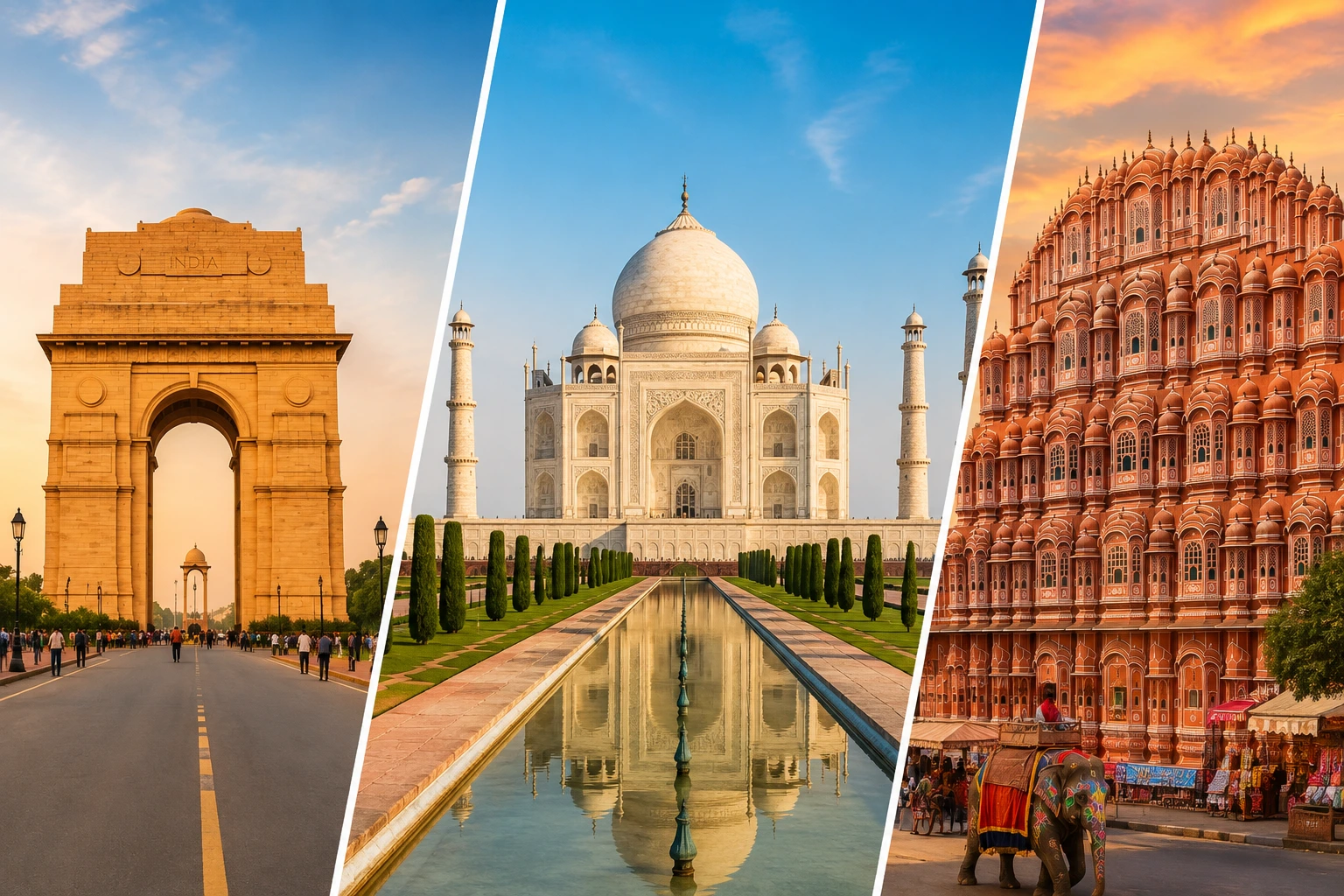
There is a reason most first-time visitors to India choose Delhi, Agra, and Jaipur. These three cities are close enough to form an easy travel route, but each offers a very different experience.
A well-planned Delhi Agra Jaipur itinerary brings together India’s old and modern sides. You can see Mughal monuments and British-era buildings across Delhi. The Taj Mahal is the main attraction in Agra, with Fatehpur Sikri as another important historic site nearby. Jaipur takes you into Rajasthan’s royal past, where grand palaces and forts show the city’s rich heritage.
Travelers call this route the Golden Triangle because of the rough triangle it draws on a map. It is the classic introduction to North India, and for good reason. The route packs in three UNESCO World Heritage properties, centuries of Mughal and Rajput history, and some of the country’s finest palace hotels. Everything sits within a manageable driving distance of everything else. A well-planned Golden Triangle tour is also easy to build on, whether that means adding a wildlife stop or extending into wider Rajasthan.
This guide explains how to plan the route from start to finish. You will learn how much time to spend in each city and what each place is known for. It also covers the best time to visit. Think of it as a simple travel plan to help you prepare before arriving in Delhi.
The Golden Triangle is India’s most popular tourist circuit, connecting the three cities of Delhi, Agra, and Jaipur in a roughly triangular route covering approximately 720 kilometers. The name refers to the triangular route formed when you draw a line from Delhi to Agra, Agra to Jaipur, and Jaipur back to Delhi. Delhi sits at the top, with Agra to the southeast and Jaipur to the southwest, and the whole loop covers around 720 kilometers.
Each city tells a different chapter of Indian history. Delhi has been a seat of power for over a thousand years. Each empire rebuilt on top of the last, so it carries fragments of Delhi Sultanate, Mughal, and colonial-era architecture within a single afternoon’s walk. Agra was the Mughal capital under Shah Jahan and still holds the Taj Mahal, the mausoleum he built for his wife Mumtaz Mahal. Jaipur was founded in 1727 by Maharaja Sawai Jai Singh II. It was a planned city from its first brick, laid out on principles of Vedic architecture. In 1876, the city was painted pink to welcome the Prince of Wales, a color it has kept ever since.
Distance and drive time between the cities:
| Route | Distance | Typical Drive Time |
| Delhi to Agra | 233 km (145 miles) | 3.5 to 4.5 hours via the Yamuna Expressway |
| Agra to Jaipur | 242 km (150 miles) | 3.5 to 4.5 hours via NH21 Highway |
| Jaipur to Delhi | 311 km (193 miles) | 5 to 6 hours via NH48 Highway |
Traffic, weather, and truck congestion on national highways can stretch these times, so private guides typically build in a buffer rather than cutting it close.
This is the single most common planning question, and the honest answer depends on how you like to travel.
A four- or five-day trip is workable if your only goal is to see the headline monuments: the Taj Mahal, Agra Fort, Amber Fort, and Delhi’s major sites. It moves fast, with early starts and long drive days, and it suits travelers on a tight schedule who would rather see India once than not at all.
A 7 to 10 day trip is where the Golden Triangle actually opens up. This gives each city two full nights. You get room for a walking tour through Old Delhi’s lanes, and time to see the Taj Mahal at both sunrise and sunset instead of just once. There’s also a half day free for Jaipur’s bazaars, where block-printed textiles and gemstones make for the best souvenir hunting on the trip. Many travelers also use the extra days to add Ranthambore National Park for a tiger safari, or Udaipur for its lake palaces. Most seasoned India travelers consider this the sweet spot.
Anything beyond 10 days generally means folding in a fourth stop, whether that is Varanasi for the Ganges ghats, Udaipur for romance, or a wildlife detour to Ranthambore or Bandhavgarh.
Delhi offers a mix of old-world charm and modern city life. Old Delhi was built by Shah Jahan in the 1639 and was once known as Shahjahanabad. Today, the area is busy and full of character.
Take a walk through Chandni Chowk or explore it by cycle rickshaw. You will find spice shops, sweet stalls, and old stores along the narrow streets. Many family-run businesses have been here for generations.
The Jama Masjid is one of the main landmarks in Old Delhi. The Red Fort is also nearby. It was built by Shah Jahan and served as the main seat of Mughal power for more than 200 years. Today, the Red Fort is a UNESCO World Heritage Site.
New Delhi, laid out by British architect Edwin Lutyens in the early twentieth century, feels entirely different: wide avenues, government buildings, and the sweeping green expanse around India Gate. Humayun’s Tomb is often called a dress rehearsal for the Taj Mahal, since it shares the same Persian garden-tomb style. Along with the soaring Qutub Minar minaret, it rounds out Delhi’s UNESCO trio.
Agra is best known for the Taj Mahal. Many visitors come to the city mainly to see this iconic monument. However, Agra is worth more than a quick stop.
Plan to spend at least a full day in the city. This gives you enough time to visit the Taj Mahal and explore other historic sites nearby. If you want to stay close to the monument, Oberoi Amarvilas is a popular option. The hotel is only about 600 meters from the Taj Mahal and offers views of the monument from every room.
Go at sunrise, when the marble shifts from soft pink to blinding white as the light climbs, and the crowds are thinnest. Agra Fort, a red sandstone fortress on the Yamuna River, is where Shah Jahan spent his final years, imprisoned by his own son. He reportedly spent those years gazing out at the Taj Mahal he had built for his late wife. Mehtab Bagh, a garden directly across the river, gives a rare unobstructed view of the monument’s back facade, particularly striking at sunset.
Many itineraries also add Fatehpur Sikri, the abandoned red sandstone city built by Emperor Akbar in the 1570s. It was deserted within fifteen years, and today it’s usually visited on the drive between Agra and Jaipur.
Jaipur rewards slow exploration. Amber Fort, perched on a hill outside the city, is the single most photographed site here. Its courtyards and mirrored Sheesh Mahal hall were built to catch candlelight in a thousand tiny reflections. Inside the city, the City Palace complex is still partly home to Jaipur’s royal family. Hawa Mahal, the honeycombed Palace of Winds, was built so the women of the royal household could watch street life below without being seen themselves. Jantar Mantar, an eighteenth-century astronomical observatory of stone instruments, remains startlingly accurate even today. Travelers wanting a heritage stay in the city itself often choose Taj Rambagh Palace, one of Rajasthan’s most celebrated palace hotels.
Jaipur is also where shopping earns its own time slot. Johari Bazaar for jewelry, Bapu Bazaar for textiles, and the block-printing workshops of nearby Sanganer are where many travelers do their most memorable souvenir hunting on the whole trip.
Packing smart makes a big difference on this trip. Here are the essentials:
When NOT to Visit:
Avoid April to June if possible. Temperatures in Delhi and Agra regularly exceed 40°C (104°F) and can reach 45-47°C (113-117°F), making daytime sightseeing exhausting and sometimes unsafe. The monsoon season (July-September) brings high humidity and periodic heavy rain, which can disrupt travel plans and make outdoor monument visits uncomfortable, though the landscapes turn lush and crowds thin out. December and January mornings can bring dense fog around Agra, occasionally delaying sunrise Taj Mahal viewings.
| Season | Months | What to Expect |
| Winter | October to March | Cool mornings (10-25°C / 50-77°F), clear skies, best sightseeing conditions, peak season |
| Summer | April to June | Very hot, often exceeding 40°C (104°F) in Delhi and Agra, fewer crowds and lower rates |
| Monsoon | July to September | Humid with periodic heavy rain, lush landscapes, thinner crowds at monuments |
Winter is, without much debate, the best window for this route, a pattern that holds true across Rajasthan more broadly. Mornings are crisp enough for a jacket, afternoons are pleasant for walking, and visibility is at its clearest for photographing the Taj Mahal. December and January can bring early morning fog around Agra, which occasionally delays sunrise viewings, so building a little flexibility into the schedule helps.
If your dates only work for summer, plan sightseeing for early morning and late afternoon, and treat midday as time to rest indoors.
Most travelers choose a private car with a driver to travel between Delhi, Agra, and Jaipur. It gives you more flexibility and lets you stop at places along the way. You can visit Fatehpur Sikri or Abhaneri Stepwell as part of your journey.
The Gatimaan Express is a good option for traveling from Delhi to Agra. The train takes less than two hours and can save you time on the road.
Flights are also available between some of these cities. However, they may not save much time once you include airport transfers and check-in time. For most travelers, a car or train is more convenient.
Travelers with extra days on the calendar often build one of these onto the classic route:
Each of these turns a Golden Triangle trip into a broader introduction to North India. A private, tailor-made India tour makes it straightforward to fold any of them in without disrupting the pacing of the original three cities.
Most travelers are comfortable with 6 to 8 days, giving each city two nights. A rushed version can be done in 4 days, while 9 to 10 days allows an add-on like Ranthambore.
October through March offers the coolest, clearest weather and is considered the ideal window for sightseeing.
A private car offers more flexibility and lets you stop at sites like Fatehpur Sikri along the way. The Gatimaan Express train is a fast, comfortable option specifically for the Delhi-Agra leg.
Yes. Ranthambore, Udaipur, Varanasi, and Amritsar are the most common additions, and all connect easily by road or short flight from the three main cities.
A knowledgeable local guide is not mandatory but adds considerable depth. This is especially true at sites like Fatehpur Sikri and Amber Fort, where the history is not always evident from the architecture alone.
Modest clothing that covers shoulders and knees is expected at mosques and temples, and headscarves are sometimes required for women. Comfortable, easily removable shoes are useful since footwear comes off at several sites.
Most Golden Triangle tour packages include private car transportation with an English-speaking driver for the entire circuit, accommodation for 5-6 nights (hotels vary by budget tier), daily breakfast, and sometimes monument entry fees. Many packages also include guided tours at major sites like the Taj Mahal, Agra Fort, and Amber Fort. Exclusions typically include lunch and dinner, personal expenses, tips, camera fees at monuments, and optional activities like cultural shows or shopping tours. Always confirm inclusions and exclusions in writing before booking, as offerings vary widely between operators.
Yes, the Golden Triangle is one of India’s safest and most tourist-friendly circuits, with well-established infrastructure and a constant presence of other travelers. Solo female travelers should take standard precautions: dress modestly (covering shoulders and knees) at religious sites, avoid walking alone late at night in unfamiliar areas, use reputable hotels and pre-arranged transport, and keep a charged phone with local emergency numbers. Many women travel this route solo without incident. Hiring a private car with a vetted driver or joining a small group tour adds an extra layer of security and convenience.
Our travel experts are here to help you craft the perfect itinerary — stress-free and tailored just for you.
Contact Our Travel Experts
India is a place that has nature that remains wild and natural. As you go through the forests, grasslands, and…
Kerala Ayurveda It’s an irony of the times we live in, which is little appreciated, though taken for granted: Alternative…
Going to Ranthambore? Nice place to pal around with tigers. But if you find them big cats too close for…
By:Bespoke admin
April 18, 2010
Kerala Ayurveda It’s an irony of the times we live in, which is little appreciated, though taken for granted: Alternative medicine is today main-stream and…
Read Post
By:Bespoke admin
June 11, 2010
If nature is the only thing you need to recuperate, travel to Alappuzha and experience a remix of your life and the elements playing…
Read Post
By:Bespoke admin
July 25, 2020
“Sat Sri Akaal” means “Truth is the name of God”, you will always be greeted by a “Sat Sri Akaal” when in Amritsar Punjab. Home…
Read Post